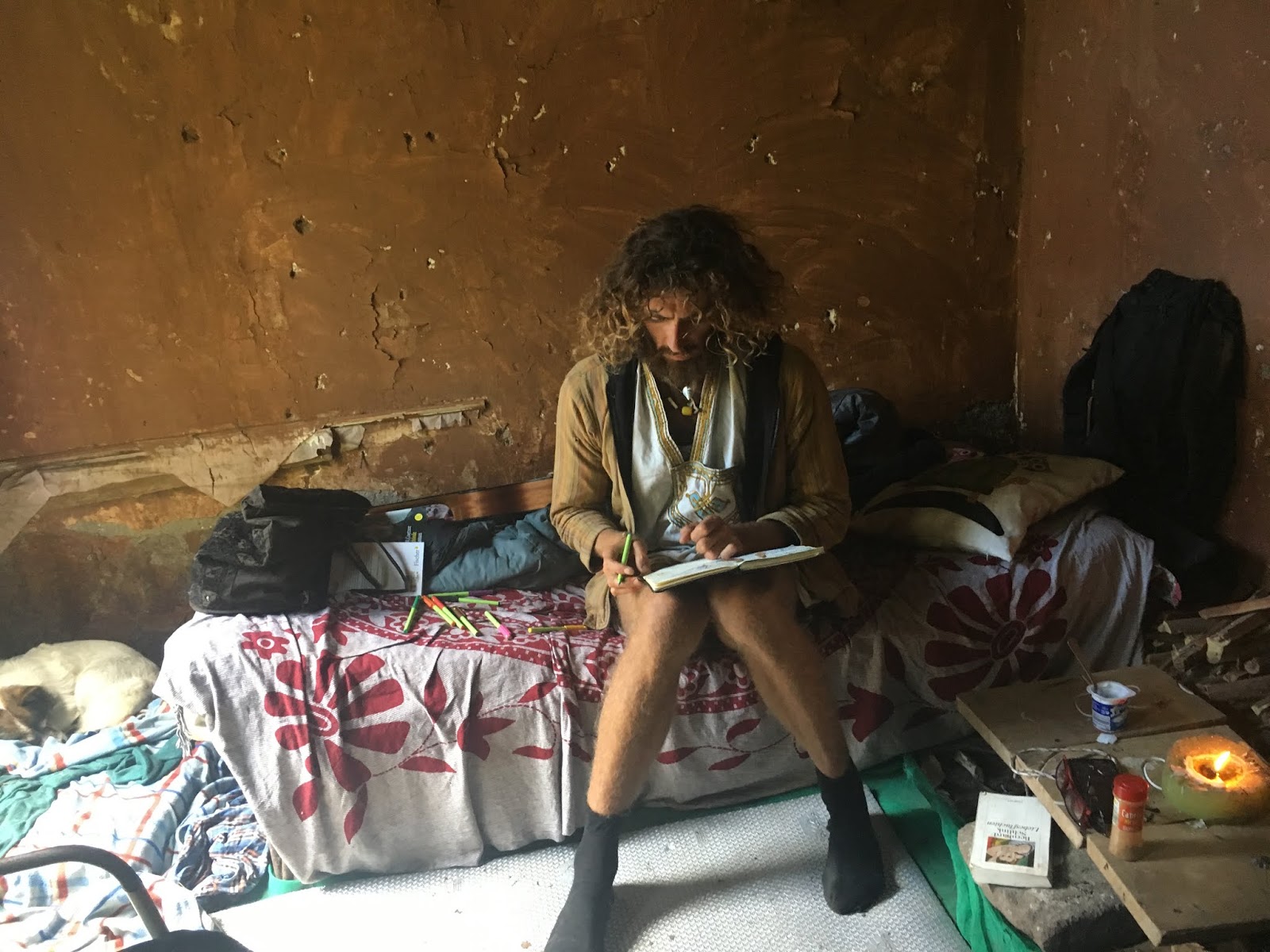
sabato 8 settembre 2018

a few jumbled Richard Holloway quotes

jumbled is the right word.  I know that taking words out of their context, paraphrasing here and there - having scribbled down the snippets that most appealed to my attention at the time - to now jumble them all together does not do much justice to Richard Holloway's autobiography Leaving Alexandria, but I wanted to share these snippets anyway, to give a flavour, and a reading recommendation.

Holloway writes eloquently, honestly, with clarity and ease, with intellect and insight yet without guile.  He writes really well.  Holloway may be of interest to those of a religious persuasion because he comes from their camp yet recognises the importance of doubting.  He may be of interest to non religious types in that, alongside his scepticism and doubts, he looks at religion tenderly.  He carefully considers the question and concludes, ''I cannot say whether God exists'' but this does not make him dismissive of the church.  He values the consolation that religion may offer the faithful, or the poor in spirit.  He recognises the role of religion as a comforting psychological blanket ''that protects us against the chilly winds of an empty universe''  Holloway's heartstrings chime along with Jesus': he reviews our human scene - our worries, our struggles, our stumbling misapprehensions - with tenderness, and compassion.

For Holloway, the good Samaritan is one of Jesus' flagship stories, showing that laws and religious conventions are not there to be slavishly followed, but should be overridden when a compassionate heart dictates otherwise.

For some reason, Holloway begins his book by quoting from Paul's second letter to Timothy:

''Demas hath forsaken me, having loved this present world''  

My first thought was: good for Demas, at least he loved something.  But I suppose that, in Paul's theology, this present world is a byword for material things, perhaps pleasures of the senses (as opposed to aiming for the treasures of heaven).  I say 'for some reason', but Holloway obviously identifies with Demas.  Throughout his book he writes about feeling disappointed with himself, a feeling that he has let God down.

A subtle shade of melancholia combined with unsentimental intellectual objectivity, pervaded by a Glaswegian sense of irony, compounded by his love of poetry, topped off with a yearning for transcendence all come together in Holloway to strike a rich and unique tone.  I like the modesty of his self-presentation.  He guides the reader guilelessly into his world of open-minded religious contemplation, peppering the retelling of everyday scenes with some carefully nuanced psychological commentary.  The whole thing is written with his poetic ear for a dapper turn of phrase.


The opposite of faith is not doubt, it is certainty.  Where you have certainty, you don't need faith. . . What do you do if you can no longer live with the doubt that is co-active with faith?  You try to cure yourself.  And the best cure for doubt is over-conviction.

Terry Eagleton puts it like this: ''God, if he does turn out to exist has absolutely no reason for doing so.  He is his own reason for being.''

 . . . a sense of presence at once given and denied . . . 

It is not that the presence is sometimes experienced and sometimes withdrawn: it is both at the same time, like a piece of music that consoles and makes us grieve in equal measure.

In the hills i was experiencing latency, the sense of something hidden behind what is seen. . . 

I was in a place that suggested elsewhere. I had not realised what a lovely word that was, elsewhere.

Yet there is also the mystery of latency, the sense of something just out of reach, something unseen that listens!  From that invisible listener a colossal demand has exerted itself upon some men and women, who gave themselves utterly away to it.  Jesus called it Father and offered himself to it without condition.  Since his death on his behalf countless others have followed his example.  Always a minority, they provoke discomfort, even among believers, because most people acquire only a mild version of faith and are made anxious by those who catch it badly.

Constancy is an endowment of the self that marks the good off from the rest of fitful, flitting humanity. I wanted to be good, but knew I wasn't. [. . .] Since heroically good people are rare, it is hardly surprising that they provoke envy in the rest of us.  Envy has been described as 'sorry at another's good', which is why it is the saddest sin in the book.  Because it is such a mean affair, we rarely admit to it.  We may confess other, more positive sins with relish, but we are rarely prepared to admit that another's grace has made us sad.  We find corrosive envy expressed in other spheres, such as the critic, perhaps an unsuccessful writer, who is caustic of a better writer who has won acclaim.  But the saddest manifestation of this human fault has to be envy of the good for being good.  It is really a sorrow for ourselves that life has dealt us a less attractive hand to play.  Moral goodness is not unlike those other accidents of the genetic and social lottery, good looks.  Rather than rejoicing that the good and the beautiful exist at all, it is all too human to fall into sadness because we ourselves have not been so endowed - understandable, but unattractive.  Indeed, envy at the endowments of others has ugly physical manifestations: a tightening of the features, as the face constricts into a sneer; behind the eyes a lurking sorrow and from the mouth an ugly contempt.  I remember a friend responding to another's justified reputation for goodness, 'And I suppose he shits custard'.

Tragic as it may appear, even unfair, there are good people, not so good people, and bad people.  And the big discovery we make in life is the person we have been revealed to be.  We don't have that knowledge when we start out.  We imagine there's a list of characteristics we can acquire if we fancy them, whereas the main lines of our personality were cast before we knew it.  This does not mean that we have no control over our decisions and choices.  It does mean that we will have little control over them till we acknowledge who we are and accept the reality of the hand we have been dealt to play.

My wrestling with my own compulsions, as well as my experience of the tragedies of others did not demonstrate any discernible improvement in the human condition as a result of the death of Jesus - allegedly decreed by God for our salvation.

I feared and longed for [in the words of T.S. Eliot] 'the loneliness of the night of God, the surrender required, the deprivation inflicted.'

Paul Tillich understood inner duality and the anguish of longing for a state of being he was incapable of achieving.

On my last evening I made my confession to him in the convent chapel.  As I expected, he was gentle.  He knew whereof I was made, remembered I was but dust.  And as Father Stanton used to say to the poor of 19th century London, 'You can't always expect dust to be up to the mark.'

[the drinkers in Edinburgh. . .] there was something almost holy in their dereliction, their lives stripped away to nothing
[in the soup kitchen Holloway's church opened, which turned into a homeless social hub . . .] out would come the grubby photographs, reminders of the now of then that they were powerless to bring back again.  

''sink without another care to that dread level of life itself''  . . . MacDiarmid went on to describe it as the capacity for 'mere being', and he thought it was more common in women than in men.  It is the ability to wait behind someone when the waiting is all that can be done.

the power of the church in Boston lay in withholding nothing, whereas the power of St Paul's in Edinburgh lay in withholding so much.           [my paraphrase, my emboldening]

Churches that stay open enclose themselves to the sorrows of humanity.  

Churches do not speak; they listen.  They understand helplessness and the weariness of failure, and have for centuries absorbed them into the mercy of their silence.

Apart from lurking round cathedrals, what do bishops do? [ . . . ] even the ability to act the fool can be useful.  I learned that from Desmond Tutu, who can't leave a church after the service without dancing down the aisle, especially if there's a good lively hymn to do it to.  It wasn't everywhere I got away with that, but there were one or two places in the diocese that liked the service to rock a bit, and I was always game for a bit of jiving down the nave.

They argued and challenged with that assertive democratic ease that is the cultural hallmark of America

It is as if America suffers form an auto-immune deficiency disorder that attacks the antibodies of scepticism and irony, which are there to protect us from the toxins of social hysteria and group rage.

[in Ireland] I found that [ . . . ] chaos and helplessness are never far away from anyone, that they just take you as a strong wind takes a tree, and that their victims are to be commiserated with rather than scorned [as in the U.S.]

. . . not much of that relaxed Hibernian tolerance in the US, where you either swim or sink.  

I was already clear that there was no point in negotiating with fundamentalists.  By definition, they do not negotiate.  You had to accept them as an inevitable part of the dramatis personae of the human comedy.

Anger at new annunciations is the mark of the invincibly conservative mind; it is futile because we can no more stop history than we can hold back the sea.  

this last quote refers to a traditional christian reading of the bible which says: God has spoken. God has now stopped speaking.  i.e. there are no new annunciations.  The bible contains the entirety of God's message for humanity.  For years Holloway stood up for the ordination of woman priests and the right for gay couples to get married.  He realised that calling upon developments in our moral consciousness since the bible was written will get nowhere with people who believe that all our moral directives are to be found exclusively in the bible.

venerdì 6 luglio 2018

Francisco, ¨the dude with the donkey¨

francisco told me he had been on television; i have located this video showing a clip from a local canarian tv programme which looks at the lives of people who have chosen a simple life in the country.  it gives a nice portrayal of francisco, who made a considerable impression on me:

https://www.youtube.com/watch?v=t3sxfvIAMko

seeing online his donkey perrico makes me want to share an anecdote, for its comic appeal: after eating a bowl of lentils, francisco told me that if i was returning to my cave i could accompany perrico out to a good grazing place, and that if, upon my return, i should see perrico further out, i should bring him back.  it was a simple request, and a simple misunderstanding on my part.  i assumed that francisco wanted me to bring his donkey all the way back with me.  "of course," i told myself, "francisco is past sixty now, and is glad to have my helping hand - still strong and youthful - to bring his donkey back at the end of a day's grazing."

later it became clear to me that Francisco meant me to bring his donkey back "only if his grazing has taken him close to your cave."  At the time I was convinced that Francisco wanted me to bring his donkey all the way back wherever his donkey was to be found.  As I began chasing Perrico, I soon heard Francisco hollering and whistling to me from the other hillside with some insistence, and - so convinced as I was of the idea that he wanted me to bring his donkey back - I began to reproduce his hollers and whistles, assuming that he wanted to share with me the sounds that his donkey best responded to.  What he actually wanted to communicate to me was: "no, leave the donkey alone, leave him where he is, stop stop stop!"  however how was i to understand this only through his whistles?  Francisco grew up on nearby island of la gomera where they have the fame of having developed a way of communication across hillsides by whistling, and all i could assume was that i was being privy to a bit of old time whistling savoir faire.  Amid francisco's repeated hollers and whistles, I heard him at one point blowing on his conch shell, a stirring sound which reverberated around the hillside and which awakened noble feelings within me.  I was already fatigued, but still determined  to display some sort of (non-existent!) know-how with donkeys.  I presumed that perrico probably didn't get to eat an apple very often, and thought that having given him one the other day might have made him well disposed towards me.  nothing of the sort.  instead of this, he ran away from me, and had me running doggedly after him through prickly plants which scratched my lower legs while i tried to reproduce the insistent whistles and calls which francisco was still sending me.  it was ridiculous really.   only, heaving a successful sigh of relief, upon somehow getting the donkey back to francisco's place, did i learn that that was not at all what was desired of me.  "leave him grazing, if he is grazing peacefully! he needs to graze, everyday he needs to graze"  francisco was royally put out.  it took him about twenty minutes to regain his composure.  I felt like a wolly.  Francisco had invited me to eat meat grilled over a barbecue with him, and the meat had now gone cold through all his waylaid whistling and shell-blowing.  "if you don´t understand, then ask!" he implored  - generally a good tip as regards effective communication, but what happens when one person is convinced they have understood something one way when in reality something quite different was meant?

I felt like a right numpty.  "ok, it was a misunderstanding. ok, perrico has returned a bit early from his daily grazing, but, come on, everyone is still more or less happy . . .?" i responded in a suggestive tone.

it didn´t take fransicso long to return to his habitual good humour, and to pull out his aforementioned timple and to strum it with careful understanding, while raising his raw, almost raucous - but emotionally convincing - singing voice.   francisco had open a bottle of wine which his son had gifted to him and which he said had costed seventy euros.  i kind of hoped that he might offer me a little tipple - just a little taste to taste how it tasted - but the last cup was sitting there on the table.  over time two flies had drowned therein; after a while i flicked them out for him.  Francisco caught sight of me and said "flies, ey?" and poured the whole lot down the sink.

now i think about it, i can't say that francisco showed much interest in the details of my life story.  i don't think he ever learned in which country i had grown up in - not that it matters; he saw that i showed interest in what he had to say, and that allowed our encounter to drift through hours.  i think he clearly liked me.  in the evening he said: "you are going already? ah!" - it seemed to suddenly occur to him - "here i have a bottle of wine we can share" as he reached under his sink.  "come back tomorrow morning and we will visit a neighbour who has a little shack near here by the sea", - a suggestion which, as things happen, did not come to pass.   i recall francisco saying that he had befriended many wayfarers over the years and that sometimes he finds bottles of wine or what not left for him with a little note.  i said to him "perhaps i will come back with a bottle of wine one day" and i still intend to do so.  only now i am looking for cheap flights back to scotland, because mid-august my grandmother will complete ninety years and the close family will come together.  after "ninety years" i almost want to put ninety exclamation marks, one for each year!


lunedì 21 maggio 2018

tenerife


Previously my recommendation to anyone wanting to visit a wild corner of tenerife was invariably: Masca.  do not leave the island without visiting masca.  please see masca.  it ran like a mantra; masca masca masca: the deepest, lushest barranco winding between spiring wild untouched melting pinnacles of volcanic rock.  But such a splendid barranco on an island so filled with holiday-makers does not go unnoticed.

Recently Jenifer and I struck out cautiously on a little tour of the island.  I say cautiously because I was driving the car and I hadn't driven a car in years and it took me a certain while to feel being behind the wheel again, to gauge the bulk of the car on the road and steer smoothly around even the narrowest and tightest of bends with complete security - with an almost exagerrated caution, so as to avoid awakening any type of anxiety in my passanger.

First we walked down to Cuevas Negras - an abandoned village nestled in a gentle green barranco which drops from the village of Erjos at 1000m to the sea at Los Silos.  We were going to camp out but then we met Jens - a Walt Whitman type with bushy grey beard and amused gentle eyes.  He had been living in one of the old houses by the side of the path for eleven years and seemed to be thoroughally satisfied with his lot.  He said the only inconvenience he had encountered were people stealing his fruits.  As he said this I looked up to lush boughs of an immense orange tree covered with countless gleaming orange fruits - undoubtedly the biggest orange tree i have ever laid my eyes on - and i could see what he meant.  He had an abundance of avocado trees too, and gave Jenny a big bag of their dried stones, after she had mentioned how much she always wanted to carve some.  One night, back at our cave, Jenifer dedicated about four hours to hollowing one out, intending it to be the head of a pipe, pressing in tiny glimmering stones into the sides and rubbing the finished thing in olive oil.  The next morning it had mystifyingly disappeared, and with its disappearance went Jenny´s interest in those avocado stones.  We can only assume that this was perpetrated by the rat - who we consider capable of doing things purposefully to annoy us - who perhaps felt peeved by us not having left anything tasty for him that night.

Through Jens we heard about another abandoned property we had passed but not paid any attention to along the way.  Over the years people had stayed there only briefly.  The heavy door had come off its hinges but Jenny soon saw that it would be easy to put it back in place.  Before long she was dreaming about really doing the place up.  Jenny has this characteristic, I am learning, of looking around any beautiful place she finds herself and wanting immediately to make it more habitable.  She is a powerhouse of dreams of a practical nature, utilising, somehow or other, the resources at hand. i.e. "we could use the clay soil outside to plaster over the holes around the window" or "look, someone left a tin full of seeds.  all we need to do is sprinkle them over the soil - coming back regularly and cutting the weeds back - and in a few months we can have our own vegetables!"

 The best thing about the place was the water.  The house was surrounded by luxurious green plant growth.  Trees, ferns, succulents, flowers, vines and other climbing plants.  Plants that grew on the outer walls of the house.  Moss that grew on the trees.  A bright fungal growth from the moist earth that looked like a mixture between a flower and a mushroom, or a very colourful petal-shaped mushroom.  And always the wonderful moist smell of organic growth in the air.  What a contrast to our cave 30 or 40 km to the south!  Along that arid rocky strip of coast it has become a little fixation of mine to develop a garden, necessitating frequent trips into the nearby barranco where until recently the rainwater from over a month ago still lay in the shadiest, coolest pool.  I was glad to fill bottles with 20 or 30 litres of this muddy water and carry it back to the cave because then it gave me a good feeling to distribute this magical fluid, granting the most generous splashes to my favourite plants.  The plants respond immediately.  If I give the crawling succulents a drink of water, the next day they will give me a flower.  Den wahren Geschmack des Wassers erkennt man erst in der Wuste is another German saying I have picked up from Jenny.  The true taste of water can only be appreciated in the desert.  Calling the sunny south coast of Tenerife a desert may seem like an exaggeration, but, honestly, the growing conditions there are quasi desertic compared to the moist woods we found a little bit further north.


Then we arrived right to the north, to the peninsular known as the Mountains of Anaga.  An incredible place!  It makes me excited now just to write the placename and think about what it signifies.  I could not have suspected that a place of such captivating natural history not to mention natural beauty was to be found, hidden away on the northern tip of tenerife.  Previously I had heard people talking about the fine walking opportunities of Anaga, and had even spent a day walking dubiously around the wet woods at the fringes of the protected reserve before scurrying back to the south and its sun.


Something spurred us along the coast beyond Roque de Dentro where a huge boulder lying on the hillside caught my eye.  We scrambled up and found a spacious cave with a fireplace and lots of wood and a wonderful view across to the rock.  The rock held me enthralled from the first.  I didn't know it had been given its (rather prosaic) name Inner Rock by the Spaniards until after I had climbed up.  This Francesco told me later that day, as well as clarifying many of the other questions we had regarding the place and its history.  The smaller rock further out to sea is called Roque de Fuera and is one of the few places where the endemic giant lizard is still to be found.  Climbing the inner rock is forbidden by law, something I did not know as a I waded with trepidation through the waist deep waves early in the morning.  The day before I had observed the tides and saw that at low tide it would be feasible to cross if the waves were not rough.  Jenny had told me that this north coast claims more lives every year than the south coast, where, it could be said, people are constantly being swept away by the sea.  "I hear the sea can be pretty rough here" i put to Francisco.  His eyes widened as he described how the huge rollers during storms are swept magnificently up the steep smooth side of the rock.  
"este aqui no es mar," began francisco offhand 
". . . es océano" he finished, expressing all the danger the thing contained, and the respect which it commanded, through the emphasis of its name.

I was well aware of the dangerous nature of the ocean as I first waded in.  The ocean is dangerous because unpredictable.  The waves rolling in now may pose little threat, but who can tell when the next big roller will roll in?  The poor souls who get swept away by the sea don't even suspect the lurking danger out at sea until the big wave is upon them.  Midway I grew fearful and turned back.  My voice of reason said "why take any unnecessary risks?  what do you have to gain?" but as i pondered this second question i realised how strong and irrational my desire to climb the rock was.  I could not explain it, and soon i was wading back in again, even more determined.  I am not sure to what extent I believed my inner reasoning, "even if i lose a limb or something, I will probably get off with my life, and even if i lose my life . . . well, better to have lived and died taking a stupid risk than not to have lived at all."  

I had noticed no seagulls before I began climbing the rock, and also noted next to none when back on land, but as I climbed up the rock, I was surrounded by a noisy gathering of them, who screeched and wheeled above me. Every so often one would come descending upon me, screeching past a couple of metres above my head.  I soon saw the reason why: speckled grey eggs, lying in clusters here and there hidden among the bushes, and little grey hatchlings, darting clumsily around.  I attempted to ward them away by gingerly waving a stout bamboo cane I had found washed up at the shore.  The seagulls did not mean me any harm; they merely wanted me to buzz off.

I judged the last perpendicular summit rock plug unclimbable, and turned around, permitting the gulls their peace, and allowing me to get back before the big lurking unsuspected, possibly speculated danger wave barred my way.  Later I learned that on the very top of the rock there grow about a hundred Dragon trees, ancient indigenous trees which grow slowly for hundreds of years, and which I feel attracted to.  It fills me with gladness to see a Dragon tree growing.  

Francesco told me that at the back of the rock was a cave where the Guanches laid their dead to rest, looking out over the ocean and into its endless beyond.  Two mummies - one male, one female - were found lying next to each other and taken to the museum in Santa Cruz.  Very little is known about the aboriginals of the Canary Islands, but remains of mummified corpses lead some to hypothesise that their forefathers must have had contact with the Ancient Egyptians.

Francisco impressed me by how he had set up a really lovely simple home in nature, starting from scratch. His house was homely, bothyesque, whitewashed stone surrounded by stony rugged land of cactus trees and stiff spikey agave leaves, a wild stretch of coast riven by spectacular barrancos plunging into the blue sea, and the view of its endless wide horizon. He clapped a piece of rock jutting out of the back wall of his kitchen, and showed me a photo of the very same jutting rock, surrounded by nothing but bare rock and ruins.  “This was ten years ago” he said, and his vital strength shone from his eyes with every word of the telling. The four 4 metre long beams that support the roof were carried in on the back of his donkey perrico, as well as anything heavy. “Apart from that” - Francesco nodded to his large marble tabletop - “that I carried in on my back.”

Jenny and I had given Perico an apple when we first went past. Francisco was not at home then. Jenny had looked around at the arrangement of potted plants and flowers, and the way pieces of glass had been incorporated into the simple clay walls and said, “an artist lives here.”

I was alone that day as Francesco hollered after me, “hola! Come and have a bowl of lentil stew. . . just finished eating myself. . . some bread with it?” and me feeling like a hungry boy in a fairy tale, who gets lured off his route by the whiff of something tasty. A couple of hours later Francesco had pulled out his timple - a traditional canarian stringed instrument - and was going through his repertoire of romantic mexican folksongs along with other south American ballads, looking at me meaningfully meanwhile with eyes expressing love lost or love longed for, sorrow or meaningful melancholy according to the lyric flow of the song. I always answered with eyes of enthusiastic appreciation and encouragement, until I got up from sitting so long and set about stretching and, feeling free, began to dance, my most visceral response and mode of thanks for the musical treat being offered me.

One of the questions Francisco cleared up for us was:  why are there wild mother goats roaming around with bulging breastbags pendulating heavily and obstructing significantly their free movement?  "this is a crime" explained Francisco, "it is completely illegal, but the young of the wild goats are frequently sequestrated for their tender meat, leaving their milk to uselessly gather in the mothers´ breasts.  the milk will eventually turn bad and lead to disease and the death of the mother goat"  ¨Corruption¨ was the idea I discerned as Francisco muttered some half-comment about the local government.

Francisco told me about his love for roaming around the wild parts of Tenerife, and mentioned one place which in particular has taken my fancy: barranco seco - a wild barranco north of Los Gigantes, accessed by a kilometre length tunnel through the mountain - where you will likely not meet another soul, where you descend to the sea passing a huge fig tree which when in season gives bags of fruits and close to the sea the rocks rise so abruptly, so immensely hundreds of metres high that you can’t help but be struck by their towering strength and majesty.


mercoledì 21 febbraio 2018

the stillness of the barranco de chinguarime

"i just met josé bencomo's grandson," i told jenny when i returned to the cave.

he was standing at the abandoned tomato factory as i walked past.  i should have known that he occupied a position of authority: the shiny 4x4 neaby showed that he had a key to the access road.  all i wanted was to go to the room upstairs and take the tealights somebody had left there.

"really? what did he say?" said jenny with interest.

"not much," i said.  "he said no se puede estar aquí -  that i shouldn't be there, that the abandoned property could be dangerous.  i said okay.     
are you the owner?
he nodded.
José Bencomo?
on saying this he looked at me suddenly somewhat suspiciously, as if i knew something about his identity, but i explained easily that i had seen the name written on all the cardboard boxes.   
"i am his grandson," he told me.

Jenny said that she would have so liked to have asked him a few things.  like what had led to the demise of the tomato factory?  why had it all been left abandoned?  and what would be done now with all the rubbish?  "i can't believe that, after the business went kaput, everything has simply been left lying around. in Germany that would never be allowed," jenny asserted.

thus spake the voice of german Umweltverschmutzungbewusstsein, conscious of environmental pollution, and desirous of its minimization.  "so many people in the world do not care about their impact on the environment," i remarked prosaically.  "josé bencomo's old tomato enterprise is but a drop in the ocean of world-wide environmental carelessness"

it could have been interesting to have followed jenny's line of enquiry.  josé bencomo - from my brief  encounter with him - gave me the impression of being an intelligent, reflective, amiable character.  however, i wanted to keep a low profile.  i had heard that the landowner did not view positively the fact that his barranco was used as a free campsite by countless campers all winter.  we considered ourselves fortunate to have found an unoccupied spacious cave protected from wind and rain above the banana plantation.  it wasn't right next to the sea, and presumably for that reason it had been left unoccupied.  i didn't want further conversation with the landowner to lead to me revealing this fact.  


camping in el barranco de chinguarime - on the eastern coast of the canarian island of la gomera - is the choice for the discerning german hippie who wishes to avoid the northern european winter.  it is a climate question.  although at the head of the barranco (which to my eyes looks morphologically for all the world like a wild scottish glen) is often capped by clouds - captured by the 1,000m centre of the island - no more than isolated drops of rain ever make it to the sea, and interrupt the dawn-to-dusk sunshine which otherwise pours upon the coast, and makes the place so pleasurable for those with a bent for outdoor living.  it is as if this sunwashed stretch of coast possessed a protective charm which wards off clouds and rain.  this is referred to as a microclimate.  the stillness of the barranco is incredible; isbrand commented on this: perhaps once a day an aeroplane will cross the horizon.  otherwise the place remains free from noise pollution.  if there is no wind the only sounds to be heard are the occasional buzz of a fly or the respectful twittering of a bird or two in the morning; otherwise there reigns a startling silence - a deep, penetrating, expectant silence, which pervades both day and night, and which - i suddenly realise - has been absent from my life for i don't know how long.

el barranco de chinguarime attracts altogether a different type of character to la caleta - the corresponding sunsplashed area of wild coast on neighbouring tenerife.  of course generalisations are odious; any type of person can exist at any given moment in any part of the world, but groups of people inhabiting the same place do generate a collective energy, which they cannot help but sharing, albeit to a greater or lesser degree.  i feel that the stillness i feel so powerfully in chinguarime comes not only from the minimal soundscape, but also from the fact that it is inhabited by a host of still souls.  it may seem that i communicate barely with a soul for days here, yet the mere act of crossing paths with somebody on a rocky path - and in the moment of passing exchanging eyes of watchful sunny alertness - alone constitutes communiality and could be seen as an instance of deep communication.   whereas in la caleta one may encounter inebriated brawls and drunken quarrels in which someone ends up setting fire to someone else's teepee, in chinguarime one comes across extremely tidy, discreetly disposed dwelling areas, with particularly beautiful spots treated as sacred spaces - bedecked with artfully arranged shells or feathers, perhaps in the shade of an unusually twisted bough or next to an intriguing rock formation.  one's eye may be caught by reading material which describes life as an inner search and a soul journey.  the presence of litter may not be commented upon.  i came across a pile of rusty cans and old bottles in a remote corner of the barranco one day.  they seemed so out of place that i put them in my rucksack and resolved to take them out to a public bin.  that was the time i first passed by the abandoned tomato factory at the top of hill.  Jenny´s definition of rubbish runs thus: "Mull ist Material im falschen Ort"  The abandoned building immediately seemed an appropriate place for me to let my gathered pieces of litter fall and be added to the waste products here already assembled. i explored the dilapidated buildings with a kind of horrified wonder.  everywhere lay a mass of detritus - old rusty machinery, rusty metallic drums, coils of plastic tubes, plastic canisters containing sinister chemicals, fusty fridges, dusty mattresses, and one dusty room filled entirely with hundreds - perhaps thousands - of flat, yet to be used cardboard boxes, all bedecked identically with the colourful bold print: TOMATOES.  PRODUCE OF CANARY ISLANDS.  JOSE BENCOMO.

outside i looked up to the dark clouds on the mountain, and thought that a postcard of the scene would make an artful antithesis to the typical scene promoted to tourists.  the focal point would be the big round concrete water tank (lying empty) on the brow of the rising hill.  in the foreground would be the disused row of desolate dirty white houses (presumably once used as worker's lodgings).  on the righthand side would stand the three dark palm trees, whose fronds were being tugged forlornly in the wind.


"imagine that you owned an entire barranco, like this" jenny invited me to consider, "what would you do with it?"
it was an imponderable thought - the possibilities of possessing of a large tract of wild land - a thought which expanded heavenwards with the evening stillness and became lost among the first twinkling stars.


lunedì 27 novembre 2017

the books in my life (quotes from Henry Miller)

The following words were all scribbled down, rather in a frenzy, as I read an online pdf version of Henry Miller's  The Books in my Life.  I feel automatically hooked and invigorated by Miller's style of writing.  Something within me nods vigorously at the galvanizing turn of his phrases.  Miller's way of writing, the topics of interest to him, and the tone of his voice, are unique.  He resists being categorized.  He possesses the rare capacity, and desire, to give the entirety of himself in his writing.  He has a crazy kind of exuberance which he often manages to contain in carefully turned phrases of both poetic and intellectual acuity.  He has a tendencys to get carried away, and to exaggerate to make a point.  Other times his amour propre gets the better of him, and he divagates uninterestingly.  Intellectualism, like all of life, is seen by Miller as a game, to be played punctiliously, as well as with enjoyment.  His biggest affinity is with poetry, candid presentation of self and the expression of sheer joie de vivre through writing.  My lips cannot resist curling with repulsion as I read, in Miller's early writings, the insipid descriptions of his erotic encounters in Paris, but I read stoically on and retrospectively stomach them with the thought that Miller must be taken as a whole; it somehow happened that the Brooklyn boy needed to rebel, to break the taboos of his time, to desire to share the totality of his self, and at times push his self-sharing and ebullience beyond the bounds of good taste.  I know that I would have quite liked to have met Miller, but I also feel that I have already met him - through his books, as well as youtube videos and radio interviews.  I feel that Miller possessed to an unusual degree the capacity to transmit the experience of being himself through his writing.  Apart from an experience of reading, his writings gives me a mode of seeing, and being in, the world - consisting of attitudes I desire to emulate, as well as others I wish pointedly to avoid.  In copying out and paying attention to Millers quotes thus, I hope to internalize something of his spirit of prodigal candor.  Perhaps, I tell myself, in studying his peculiar way of wielding the word I will also glean something of the secret of writing.

Miller mentions in several places that one would probably be better off reading less; that the pure experiencing of life herself is the great book most worthy of being read (or that the people he has met have been the 'living books', who have taught him more than any paper book.)  The fact remains that Miller loves to express himself through the written word, and that this love of writing has been fed and cultivated by a voracious lifelong appetite of his for reading books.  Soon after reading The Books in my Life, I read Miller's Big Sur and the Oranges of Hieronymus Bosch, from which the final few excerpts here below were taken.

The books in my life begins with a quote from Amiel:

"All is marvelous for the poet, all is divine for the saint, all is great for the hero; all is wretched, miserable, ugly and bad for the sordid soul"

And, though reading may not at first blush seem like an act of creation, in a deep sense it is [ . . .] Whether he is aware of it or not, what [the enthusiastic reader] is doing is praising God's handiwork.  For, the good reader, like the good author, knows that everything stems from the same source.  He knows that he could not participate in the author's private experience were he not composed of the same substance through and through.  And when I say author I mean Author.  The writer is, of course, the best of all readers, for in writing or "creating" as it is called, he is but reading and transcribing the great message of creation which the Creator in his goodness has made manifest to him.

The important thing is not which books, which experiences, a man is to have, but what he puts into them of his own.

... to me the cardinal fact about a writer is his ability to "exploit" the vast silence which enwraps us all.  Of all artists he is the one who best knows that "in the beginning was the Word and the Word was with God and the Word was God"  He has caught the spirit which informs all creation and he has rendered it in signs and symbols.  Pretending to communicate with his fellow creatures, he has unwittingly taught us to commune with the Creator.  Using language as his instrument he demonstrates that is is not language at all, but prayer.  A very special kind of prayer, too, since nothing is demanded of the Creator.  "Blessings on thee, O Lord!"   So it runs, no matter what the subject, what the idiom.  "Let me exhaust myself, O Lord, in singing thy praises"

As a philosophy of life the Tao Teh Ch'ing not only holds its own with the bulkier systems of thought propounded by other great figures in the past, but, in my mind, surpasses them in every respect.  It has one element which wholly sets it apart from other philosophies of life - humour.

Long before I had accepted Jesus Christ, I had embraced Lao-tse and Gautama the Buddha.  The Prince of Enlightenment!  Somehow, that appellation never seemed to fit Jesus.  A man of sorrow - that was more my conception of the gentle Jesus.  The word enlightenment struck a responsive chord in me;  it seemed to burn out those other words associated, rightly or wrongly, with the founder of Christianity.  I mean words such as sin, guilt, redemption, and so on.

To write one has to be possessed and obsessed.  What is it that possess and obsesses Cendrars?  Life.  He is a man in love with life - et c'est tout.  No matter if he denies this at times, no matter if he vilifies the times or excoriates his contemporaries in the arts, no matter if he compares his own recent past with the present and finds the latter lacking, no matter if he deplores the trends, the tendencies, the philosophies and behaviour of the men of our epoch, he is the one man of our time who has proclaimed and trumpeted the fact that today is profound and beautiful.

It is in Apocalypse that [D.H. Lawrence] has some of the most moving passages - on the withering of the "societal" instinct.  They create real anguish in us - for Lawrence.  They make us realise the tortures he suffered in trying to be "a man among men."  With Cendrars I detect no hint of such deprivation or mutilation.  In the ocean of humanity Cendrars swims as blithely as a porpoise or dolphin.  In his narratives he is always together with men, one with them in deed, one with them in thought.  If he is a solitary, he is nevertheless fully and completely a man.  He is also the brother of all men.  Never does he set himself up as a superior to his fellow man.  

Everything is so divinely connected, so beautifully interrelated - how could one possibly be at a loss to undertake the education of a child?  Whatever we touch, see, smell, or hear, from whatever point we begin, we are on velvet.  There is no need to "prepare" a child for his lesson:  the lesson itself is a kind of enchantment.  The child longs to know; he literally hungers and thirsts.  And so does the adult, if we could but dissipate the hypnotic thrall which subjugates him.

More that ever do I believe that at a certain age it becomes imperative to reread the books of childhood and youth.  Else we may go to the grave not knowing who we are or why we lived.

Only once is it given to experience the miracle of life.  The import of this dawns slowly, very slowly upon me.  Whoever has not become fully alive in this life will not become so through death.  I believe this to be the hidden note in all religious teachings.

The rebel, I firmly believe, is closer to God that the saint.  To him is given dominion over the dark forces which we must obey before we can receive the light of illumination.  The return to the source, the only revolution which has meaning for man, is the whole goal of man.  It is a revolution which can occur only in his being.  This is the true significance of the plunge into life's stream, of becoming fully alive, awakening, recovering one's complete identity.
Identity!  This is the word which [. . .]  has come to haunt me.  I began my writing career with the intention of telling the truth about myself.  What a fatuous task!  What can possibly be more fictive than the story of one's life?  We reveal nothing of ourselves by telling the truth, but do sometimes discover ourselves.  I who had thought to give something found that I had received something.  

. . . of what stupendous, unimaginable detours are our lives composed!  All is voyage, all is quest.  We are not even aware of the goal until we have reached it and become one with it.

To employ the word reality is to say myth and legend.  To speak of creation means to bury oneself in chaos.  We know not whence we come, nor whither we go, nor even who we are.

. . . the understanding of a language is not the same as the understanding of language.  It is always communion versus communication.

Giono's "Song of the world" is far more precious, far more stirring, far more poetic than the "Song of songs."  It is intimate, personal, cosmic, untrammeled - and ceaseless.  It contains the notes of the lark, the nightingale, the thrush; it contains the whir of the planets and the almost inaudible wheeling of the constellations;  it contains the sobs, shrieks and wails of wounded mortal souls as well as the laughter and ululations of the blessed.  It contains the serahphic music of the angelic hosts and howls of the damned.  In addition to this pandemonic music, Giono gives the whole gamut of colour, taste, smell and feel.  The most inanimate objects yield their mysterious vibrations.  The philosophy behind this symphonic production has no name:  its function is to liberate, to keep open all the sluices of the soul, to encourage speculation, adventure and passionate worship.  "Be what thou art, only be it to the utmost!"  That is what it whispers.

Certain books not only give a sense of life, sustain life, but, like certain rare individuals, augment life.

In youth, one's appetite, both for raw experience and for books, is uncontrolled.  Where there is excessive hunger, and not mere appetite, there must be vital reasons for it.  It is blatantly obvious that our present way of life does not offer proper nourishment.  If it did I am certain we would read less, work less, strive less.  We would not need substitutes, we would not accept vicarious modes of existence.  This applies to all realms:  food, sex, travel, religion, adventure.  
We have no definite goal or purpose, nor the freedom of being without goal or purpose.  We are, most of us, sleepwalkers, and we die without ever opening our eyes.

From early manhood on my whole activity revolved about, or was motivated by, the fact that I thought myself, first potentially, then embryonically, and finally manifestly, as a writer [. . . ] here is my genealogical line:  Boccaccio, Rabelais, Whitman, Emerson, Thoreau, Maeterlinck, Romain Rolland, Plotinus, Heraclitus, Nietzsche, Dostoievsky, the ancient Greek dramatists, the Elizibethan dramatists (excluding Shakespeare) , Theodore Dresier, Knut Hamsun, DH Lawrence, James Joyce, Thomas Mann, Elie Faure, Oswald Spengler, Marcel Proust, Van Gogh, the dadaists and surrealists, Balzac, Lewis Caroll, Nijinsky, Rimbaud, Blaise Cendrars, Jean Giono, Celine, everything I read on Zen Buddhism, and of course the Bible, the men who wrote it and especially the men who made the King James version, for it was the language of the bible rather than its "message" which I got first and which I will never shake off.  

What were the subjects which make me seek the authors I love, which permitted me to be influenced, which formed my style, my character, my approach to life?  Broadly these: the love of life itself, the pursuit of truth, wisdom and understanding, mystery, the power of language, the antiquity and the glory of man, eternality, the purpose of existence, the oneness of everything, self-liberation, the brotherhood of man, the meaning of love, the relation of sex to love, the enjoyment of sex, humour, oddities and eccentricities in all life's aspects, travel, adventure, discovery, prophecy and magic (both black and white), art, games, confessions, revelations, mysticism, more particularly the mystics themselves, the varieties of faith and worship, the marvellous in all realms and under all aspects, for "there is only the marvellous and nothing but the marvellous"

. . . the struggle of the human being to emancipate himself, that is, to liberate himself from the prison of his own making, that is for me the supreme subject . . .

Perhaps that is why, in my works, I have given so much space to sheer experience of life.  Perhaps too that is why I am so powerfully drawn to the men of wisdom, the men who have experienced life to the full and who give life - artists, religious figures, pathfinders, innovator and iconoclasts of all sorts.  And perhaps - why not say it? - that is why I have so little respect for literature, so little regard for the accredited authors.  For me the only true revolutionaries are the inspirors and activators, figures like Jesus, Lao-tse, Gautama the Buddha, Akhnanton, Ramakrishna, Krishnamurti.  The yardstick I employ is life: how men stand in relation to life.  What distinguishes the men I have in mind is that they did not impose their authority on man; on the contrary, they sought to destroy authority.  Their aim and purpose was to open up life, to make man hungry for life, to exalt life - and to refer all questions back to life.  They exhorted man to realise that he had all the freedom in himself, that he was not to concern himself with the fate of the world (which is not his problem) but to solve his own individual problem, which is a question of liberation, nothing else.

[the painters'] signs and symbols are of another order than the writer's or thinker's.  They deal in forms and images, and images have a way of remaining fresh and vivid.  I feel that the painter looks at the world more directly.

[whereas the thought which haunts our youth] is - will this world be snuffed out before we have a chance to enjoy it? - there is no-one to tell them that even if the world were snuffed out tomorrow, or the day after, it would not really matter - since the life they crave to enjoy is imperishable.

The way one reads a book is the way one reads life.  Maeterlinck writes as profoundly and engagingly about insects, flowers, stars, even space itself, as he does about men and women.  For him the world is a continuous, interactive, interchanging whole.  There are no walls or barriers.  There is no death anywhere.  A moment of time is as rich and complete as ten thousand years.  Truly, a luxurious kind of thinking.  

. . .  besides, what could it possibly mean to a man like him to lose a game of chess, or ten games, or a hundred?  "I'll be playing it in paradise" he seemed to be saying, "Come on, let's have fun! Make a bold move, a rash move!"  The way he played chess was the way he played the game of life.

Sometimes, when the image of Lao-tse seated on the back of a water buffalo crosses my mind, when I think of that steady, patient, kindly, penetrating grin of his, that wisdom so fluent and benevolent, I think of Lou Jacobs sitting before me at the chessboard.  Ready to play the game any way you liked.  Ready to rejoice over his ignorance or to beam with pleasure at his own tomfoolery.  Never malicious, never petty, never envious, never jealous.  A great comforter, yet remote as the dog star.

Like Celine, Powys has the faculty of telling of his misfortunes with humour.  Powys, needless to say, had his own luminaries whom he raved about.  I use the word "raved" advisedly.  I had never before heard anyone rave in public, particularly about authors, thinkers, philosophers.  Powys fulminated with the fire and smoke of the soul, or the depths which cradle the soul.  Literature was for him like manna from above.

Fatidical, if I remember rightly, was one of his favourite adjectives.

All vital questions were of interest to him.  It was his broad yet passionate curiosity which enabled him to wrest from "dead" epochs and "dead" letters the universal human qualities which the scholar and pedant lose sight of.  To sit at the feet of a living man, a contemporary, whose thoughts, feelings and emanations were kindred in spirit to those of the glorious figures of the past was a great privilege.  

"You seek truth," says Krishnamurti, "as if it were the opposite of what you are"

If Krishnamurti has a mission, it is to strip men of their illusions and delusions, to knock away the false supports of ideals, fetishes, every kind of crutch and thus render back to man the full majesty, the full potency, of his humanity.

Alice, too, was in a quest for reality and proved her courage poetically by stepping through the looking-glass.

"Become as little children"  Everyone bows his head in silence when this utterance is repeated.  But no-one truly believes it.

. . . teachers in the true sense - those who open our eyes, those who lift us out of ourselves.  They are not interested in foisting upon us new beliefs but in aiding us to penetrate reality more deeply.  They proceed first by levelling all the superstructures of thought.  Second they point to something beyond thought, to the ocean of mind, let us say, in which thought swims.  Last they force us to think for ourselves.

"Now, today, as I write, I stand in exactly the same position as the Caveman.  Written tradition, systems of culture, modes of thought, have for me no existence."  [Miller here is quoting a French author, I remember not whom] That is a mighty utterance.  An heroic utterance.  Who can repeat it honestly and sincerely?  Who is there that even aspires to make such an utterance?

Aye, we must go full swing.  Home - where is it if not everywhere and nowhere at the same time?  When he is in possession of his soul, then will man be fully alive, caring nothing for immortality and knowing nothing of death.  To begin wholly fresh may mean coming alive at last!

It makes grand sense, one's life, even when it resembles a quagmire.  Certainly no Creator could have ordained the devious and manifold paths one treads, the choices and decisions one makes.  Can you imagine a ledger in which the vagaries of every single mortal that ever lived were recorded?

Dostoievsky was human in that "all too human" sense of Nietzsche.  He wrings our withers when he unrolls his scroll of life.  Whitman is impersonal by comparison; he takes in the crowd, the masses, the great swarms of humanity.  His eyes are constantly fixed on the potential, the divine potential in man.  He talks brotherhood.  Dostoievsky talks fellowship.  Dostoievsky stirs us to the depths, causes us to shudder and grimace, to wince, to close our eyes at times.  Not Whitman.  Whitman has the faculty of looking at everything, divine or demonic, as part of the ceaseless, Heraclitean stream.  No end, no beginning.  A lofty, sturdy wind blows through his poems.  There is a healing quality to his vision.  Compared to Dostoievsky Whitman is in a sense empty.  It is not the emptiness of the abstract either.  It is rather a divine emptiness.  It is the quality of the nameless void out of which sprang chaos, it is the emptiness which precedes creation,  Dostoievsky is chaos and fecundity. [ . . . He] seems to me to glow with a human light and he is thought of as a fanatic, as a demonic being; Whitman radiates a cool cosmic light, and he is thought of as the brother of all men, as the man in the midst of life.  Dostoievsky is all passion, Whitman compassion.  In Dostoievsy's work one has the feeling that the angel and the devil walk hand in hand; they understand one another and they are tolerant of one another.  Whitman's work is devoid of such entities; there is humanity in the rough, there is nature grandiose and eternal, and there is the breath of the Great Spirit.

Our destination is never a place but a new way of seeing things.

You will be very disappointed in heaven, for I think that it won't nearly be as nice there as it is here.

"I feel and know that death is not the ending, as we thought, but rather the real beginning - and that nothing ever is or can be lost, nor even die, nor soul, nor matter"
Whitman

"The world will be complete for him who is himself complete"
Whitman

How very Zen is this from Whitman:  "Is it lucky to be born?  It is just as lucky to die"

The questioning, the doubts, the denial which abound in Dostoievsky's works, revealing his obsession with the problem of certitude, stand in sharp contrast to Whitman's lifelong attitude.  In some respects, Dostoievsky reminds us of Job.  He arraigns the Creator and life itself.

"Unable to accept life spontaneously, [Dostoievsky] was compelled to take it up as a problem," writes Janko Lavrin, "but life as a problem demands a meaning which must satisfy our rational and irrational selves. At a certain stage the meaning of life may even become more important than life itself.  One can reject life altogether, unless its meaning answers to the highest demands of our consciousness."

Dostoievsky undertook, as far as it was humanly possible, to assume the problems, the tortures and the anguish of all men - and especially, as we know so well, the incomprehensible suffering of children.  Whitman answered man's problems, not by weighing them and examining them, but by a continuous chant of love, of acceptance, in which the answer was always implicit.

"Whitman's essential message," says Lawrence, "was the Open Road, the leaving of the soul free unto herself, the leaving of his fate to her and the loom of the open road.  Which is the bravest doctrine man has ever proposed to himself"

Singing the song of the soul himself, Lawrence grows ecstatic.  He speaks of "a new morality, a morality of actual living, not of salvation."  Whitman's morality, he declares, "was a morality of the soul living her life, not saving herself . . . the soul living her life along the incarnate mystery of the open road."

"fate leads the willing, drags the unwilling"

Lawrence was frightened, nay horrified, to think that his man Whitman, in accepting everything, rejecting nothing, lived with all his sluices open - like some monstrous creature of the deep.

But could there be a more salutary comforting image than this human net adrift in the stream of life?  Where would you have man anchor?  Where would you have him take root?  Is he not divinely poised - in the eternal flux?

"The revilers of war are like the revilers of thunder, storms and volcanoes," Amiel declares - and this is a line which must have sunk deep in me, for whenever I encounter it it resounds like a tocsin, "Catastrophes bring about a violent restoration of equilibrium; they put the world brutally to rights."

Life has no other discipline to impose, if we would but realise it, than to accept life unquestioningly.

[Miller describing his neighbours at Big Sur]
 [. . .] they have freedom in their blood and a recklessness for consequences which can only spring from a firm belief in the triumph of love [. . .] the extraordinary indulgence which they manifest [. . .] is born of superabundant spirit.  It is directed towards everything capable of growth, whether plant, creature, child, artist or idea.  In obeying this impulse to nurture and sustain the life spirit, they grow in like measure and are nurtured, sustained and fortified by the very powers they have called into play.

If there is a genuine need, it will be met.  First you will have to prove that your need is genuine.  These questions will be put to you: "How would you order the world if you were given the powers of the Creator?" and "What is it you desire that you do not already possess?"

The task of genuine love.   Sit down, wherever you are, and let your mind dwell on these words.  Ask yourself if, in all the years you have been dwelling on this planet, you have ever given a moment's thought to such a problem.

As for Jesus, by all accounts he didn't own a toothbrush, no baggage, no furniture, no change of linen, no handkerchief, no passport, no bank-book, no love letters, no wife, no children.  As far as we know, he never wrote a line.  Home was wherever he happened to be.  He had no wants, that's the thing.

The world problem, said Krishnamurti once, is the individual problem; if the individual is at peace, has happiness, has great tolerance, and an intense desire to help, then the world's problem as such ceases to exist.  

"I am convinced that to maintain oneself on this earth is not a hardship, but a past-time, if we will live simply and wisely."  
Thoreau
     
It is only the poetic aspect of anything which really interests me.  In the ultimate there is only one language - the language of truth. 

martedì 10 ottobre 2017

Emerson's Essays (or jumbled quotes therefrom)

Brother Gerry made a passing remark to me this summer, which has set me along a path of affirmation and discovery.  His words to me had the effect of saying:  "you are an individualist, in the style of Emerson."  I already had a latent interest in Emerson - through reading of his associations with Walt Whitman and Henry David Thoreau - and decided to go straight to the horses mouth, and see to what degree I agreed with the man.

The pocket-sized, leather-bound copy of his Essays and Representative Men, which I borrowed from Elgin library, looked like a Gideon's bible and I have come to employ it as such: carrying it about with me everywhere I go, unable to put the thing down, imagining that it might even save my life if somebody ever decided to shoot at my coat pocket.  I am so glad that Emerson decided to write his ideas down and permit a lad in the north-east of Scotland to peer into his mind.  His writing affirm thoughts which were already in my head, and introduced a few more besides.  And they are expressed so pleasingly: a real pleasure to read.  I started scribbling down the words that most struck me, then realised that I would end up copying down half the book and that the best thing would be to procure my own copy, and be able to reread it at will.

It took me a while to tune into Emerson's early eighteenth century language. His expressions are not only thusly dated but also constructed in his own idiosyncratic style.  However, Emerson had something to say on this point: that whosoever speaketh of eternal truths, speaks timelessly, and writes unbound to the particularities of their time.  Shakespeare's dialogues are such a realistic portrayal of human nature, it is as if they are occurring here and now in front of the reader.  The insatiable intellectual inquiry of Plato is recorded in terms whose tone could be mistaken for that of a modern writer.

Further reading soon led me into a full appreciation of Emerson's pithy, stylish turns of phrase, and his lapidary mind behind them.  His pithiness lends itself felicitously to quote plucking.

Emerson's emphasis on the self-reliance and "infinitude of the private man" is placed within his underlying pantheism.  Everything is united; All is One; each seemingly distinct incidence occurring within time and space is simply yet another manifestation of the same underlying spiritual reality; in the same way that each individual mushroom appearing above ground is but a superficial excrescence of an invisible underground network, containing, as it were, the Platonic idea of mushroomness. Emerson gives me the image of material reality seen like a kaleidoscope: manifold shining shapes together creating momentarily a pattern, soon to tumble onward, ever subject to the wheel of life's tireless rotations and the creation of ever new reconfigurations.

This puts me in mind of Alan Watts' notion of the material universe as God playing hide-and-seek with himself.  This game analogy should not be seen to trivialise the import of existence, but rather may help to give it meaning to those who see none.  Playing a game may have several purposes, not least of which being that it is an interesting way to allow time to pass.  How else would God decide to spend infinity?

An idea that Emerson has affirmed for me is that I am (a microcosm of) the entire cosmos (giving a whole new meaning to the phrase "I feel whole.")  I carry the world within me.  As within, so without.

This puts me in mind of my idea that the world is not only an interpretation seen by each mind, but also the representation of the interpretation of the self.  The relationship you have with yourself is the same as the relationship you have with the world.  If you are entirely at peace with yourself, so will you be with the whole world.  If you do not accept parts of yourself, so will you have misgivings about parts of the world.

Emerson's essays were first delivered as lectures all over America before being published.  He exhorted his listeners, and later his readers, to feel in nowise inferior to the glory of illustrious civilizations - whether they be the Greeks of yesteryear or contemporary Europeans.  The same spirit animating the whole of Nature may manifest itself here and now as well as anywhere else in the world at any other time.  Only sixty years after America gained independence, Emerson's emphasis on the strength of selfhood had the wider significance of strengthening a new sense of American nationhood.  His lectures were described as "America's intellectual declaration of independence"


Nothing is at last sacred but the integrity of your own mind.  Absolve you to yourself and you shall have the suffrage of the world.

If I am the Devil's child then I will live from the Devil.  No law can be sacred to me but that of my nature.

Men do good actions much as they would pay a fine in expiation of a daily non-appearance in parade.  Their works are done as an apology or extenuation of living in the world.  Their virtues are penances.  I do not wish to expiate but to live.

It is easy in the world to live after the world's opinions; it is easy in solitude to live after our own but the great one is he who in the midst of the crowd keeps with perfect sweetness the independence of solitude.

Suppose you should contradict yourself?  What then?  With consistency a great man has simply nothing to do.  Speak what you think now in hard words, and tomorrow [do the same],  though it contradict everything you said today.  Is it so bad to be misunderstood?  Pythagoras was misunderstood, and Socrates, and Jesus, and Luther, and Copernicus, and Galileo, and Newton, and every pure and wise spirit that ever took flesh.  To be great is to be misunderstood.

It is as easy for the strong man to be strong, as it is for the weak to be weak.

We must go alone.

I like the silent church before the service begins, better than any preaching.

Every man in his lifetime needs to thank his faults.  The wise man throws himself on the side of his assailants.  It is more his interest than theirs to find his weak point.

In general, every evil to which we do not succumb is a benefactor.

Men suffer all their life long under the false superstition that they can be cheated, but it is impossible for a man to be cheated by any one but himself.

Nothing can work me damage except myself, the harm that I sustain I carry about with me, and never am a real sufferer but by my own fault.

...for it is only the finite that has wrought and suffered, the infinite lies stretched in smiling repose.

The rich man lies in the sun and sleeps, and is Nature.

A little consideration of what takes place around us every day would show us that a higher law than that of our will regulates events; that our painful labours are unnecessary and fruitless, that only in our easy, simple, spontaneous actions we are strong.

Like draws to like, the goods which belong to you gravitate to you, and need not be pursued with pains and cost.

"my children," said an old man to his boys, scared by a figure in the dark entry, "you will never see anything worse than yourselves."

When a man speaks the truth in the spirit of truth his eye is as clear as the heavens.  When he has base ends, and speaks falsely, the eye is muddy and somewhat asquint.

A work of art, of whatever kind, sets us in the same state of mind wherein the artist was when he made it.

The wisdom of the wise man consists herein, that he does not judge [people]; he lets them judge themselves, and merely reads and records their own verdict.  That which we are we shall teach, not voluntarily, but involuntarily.  The infallible index of true progress in found in the tone a man takes.  If he have not found his home in God, his manners, his forms of speech, the turn of his sentences, the build, shall i say, of all his opinions, will involuntarily confess it, let him brave it out how he will.  If he have found his center, the Deity will shine through him.  The tone of seeking is one, and the tone of having is another.

The great man will not be prudent in the popular sense; all his prudence will be so much deduction from his grandeur, but it behooves each to see when he sacrifices prudence, to what good he devotes it; if to ease and pleasure, he had better be prudent still; if to a great trust, he can well spare his mule and panniers who has a winged chariot instead.

[Old age consists of] rest, conservatism, appropriation, inertia, not newness, not the way onward.  We grizzle every day.  I see no need of it.  Whilst we converse with what is above us, we do not grow old but young.  Infancy, youth, receptive, aspiring, with religious eyes looking upward, counts itself nothing, and abandons itself to the intuition flowing from all sides.

In nature every moment is new; the past is always swallowed and forgotten.  The coming only is sacred.  Nothing is secure but life, transition, the energizing spirit.  No love can be bound by oath or covenant to secure it against a higher love.  No truth is so sublime but it may be trivial to-morrow in the light of new thoughts.

The one thing we seek with insatiable desire is to forget ourselves, to be surprised out of our propriety, to lose our sempiternal memory, and to do something without knowing how or why; in short, to draw a new circle.  Dreams and drunkeness, opium and alcohol, are the semblance and counterfeit of this oracular genius, and hence their dangerous attraction for men.  They ask the aid of wild passions to ape in some manner those flowers and generosities of the heart.

"A man" said Oliver Cromwell, "never rises so high as when he knows not whither he is going."

The angels are so enamoured of the language that is spoken in heaven, that they will not distort their lips with the hissing and unmusical dialects of men, but speak their own, whether there be anyone who understand it or not.

The religions of the world are the ejaculations of a few imaginative men.

Mysticism consists in the mistake of an accidental and individual symbol for a universal one.  The morning-redness happens to stand to Jacob Behmen for trust and faith; and he believes should stand for the same realities to every reader.  But the first reader prefers as naturally the symbol of a mother and child, or a gardener and his bulb, or a jeweler polishing his gem.  Either of these, or a myriad more, are equally good to the person to whom they are significant.  Only they must be held lightly, and be very willingly translated into the equivalent terms which others use.  The mystic must be sternly told - all you say is true without the tedious use of that symbol as with it.

The great distinction between teachers sacred or literary, between men of the world who are reckoned accomplished talkers, and here and there a fervent mystic, prophesying, half insane under the infinitude of his thought, is that one class speak from within, or from experience, as parties and possessors of the fact; and the other class from without, as spectators merely [...] Jesus speaks always from within, and in a degree that transcends all others. 

St Augustine described the nature of God as a circle whose center was everywhere, and its circumference nowhere.

I know nothing which life has to offer so satisfying as the profound good understanding, which can subsist between two virtuous men, each of whom is sure of himself, and sure of his friend.  It is a happiness which postpones all other gratifications, and makes politics and commerce and churches cheap.

There are no fixtures in nature.  The universe is fluid and volatile.  Permanence is but a word of degrees.  Our globe seen by God is a transparent law, not a mass of facts.

Though we travel the world over to find the beautiful, we must carry it with us, or we find it not.