domenica 11 luglio 2021

brothers go camping and climb Ben Alder

Spending the last few years on Tenerife has made me lose my real lived sensory awareness of the enormity of the seasonal pendulum in Northern Europe.
Where would one be here without the summer months? ...struck with some sort of seasonal affective disorder, I'd say.
O how we need these wafts of warm air to chase away the weary dreary winter chill;
we really need to fill our eyes with lush leaves and lingering light all night.
Summer, when sleeping out on a mountain top seems feasible and really appealing,
thanks to the tilt of the planet as she orbits around the sun.
Aye, we can all do with a decent dose of summer therapy.
Thanks, tilt.


Regarding evening meals, we had arranged that we would take turns to cook over the three nights.  The first night camping at Linn of Tummel I arrived first and had baked tatties with cheese and lentils waiting warm on the embers when Kevin and Finlay arrived.  The next two nights, however, without really planning it, unable to really prevent it, we all just found ourselves mucking in - chopping onions, boiling pasta, chucking in chickpeas, creating sauces with great glugs of hoppy tasty homemade beer, thickening them with great dollops of peanut butter and great slabs of solid coconut cream.  We were all reading from the same page in our intuitive cookery book, as it were - all having worked up a similar great appetite after a great day's hiking in the hills.


One the second evening we came to a beautiful bit of sand sticking out into Loch Ericht, strewn with great bits of pine roots which were beautiful and old and gnarly and it seemed somehow profligate for us just to burn them like that on a common camp fire but it also felt special and privileged.
A man and a teenager - probably father and son - walked past with relatively small rucksacks.  We told them that we reckoned we would camp right here; they said that they would camp a bit further on.

"How do they manage to go camping, like us, but carrying so much less?"
"They are obviously not doing the same camping-cooking trip that we are"
"They are probably carrying lightweight ready meals"


What was the last night like for you?

I don't know . . . I was tired from the walking but I didn't want to go to sleep.  There was a hushed stillness in the air.  It felt like we didn't need to say anything at all.  There was nothing to say.  I kept eating things.  Our eyes would meet occasionally across the fire and we would just smile with some knowing appreciation, looking around at the stillness and slowness of the coming dawn.  

Kevin and Finlay took a dip in the loch, and came back shivering with vitality.  How was it, Kevin?  "It was cold," he emphasised, with an irrepressible grin.  "Just imagine being cold - that is what it is."  

At that point I was particularly enjoying the warmth of the fire and the thought of plunging into cold water was somewhat off-putting, but after some time I could not resist the appeal either.  However beautifully flickering and warm the flames may seem, these qualities are only enhanced when one has just come from a shocking cold loch.


Almost all these photos come from Kevin's camera.  Thanks, Kevin

mercoledì 27 gennaio 2021

the yurt


The demise of the cave led us to invest more time in the yurt on the land, which was a great place for us to lie low while lockdown was on and best of all was seeing the fulfilment of our vision when Gabriela learned to walk unaided around the yurt.

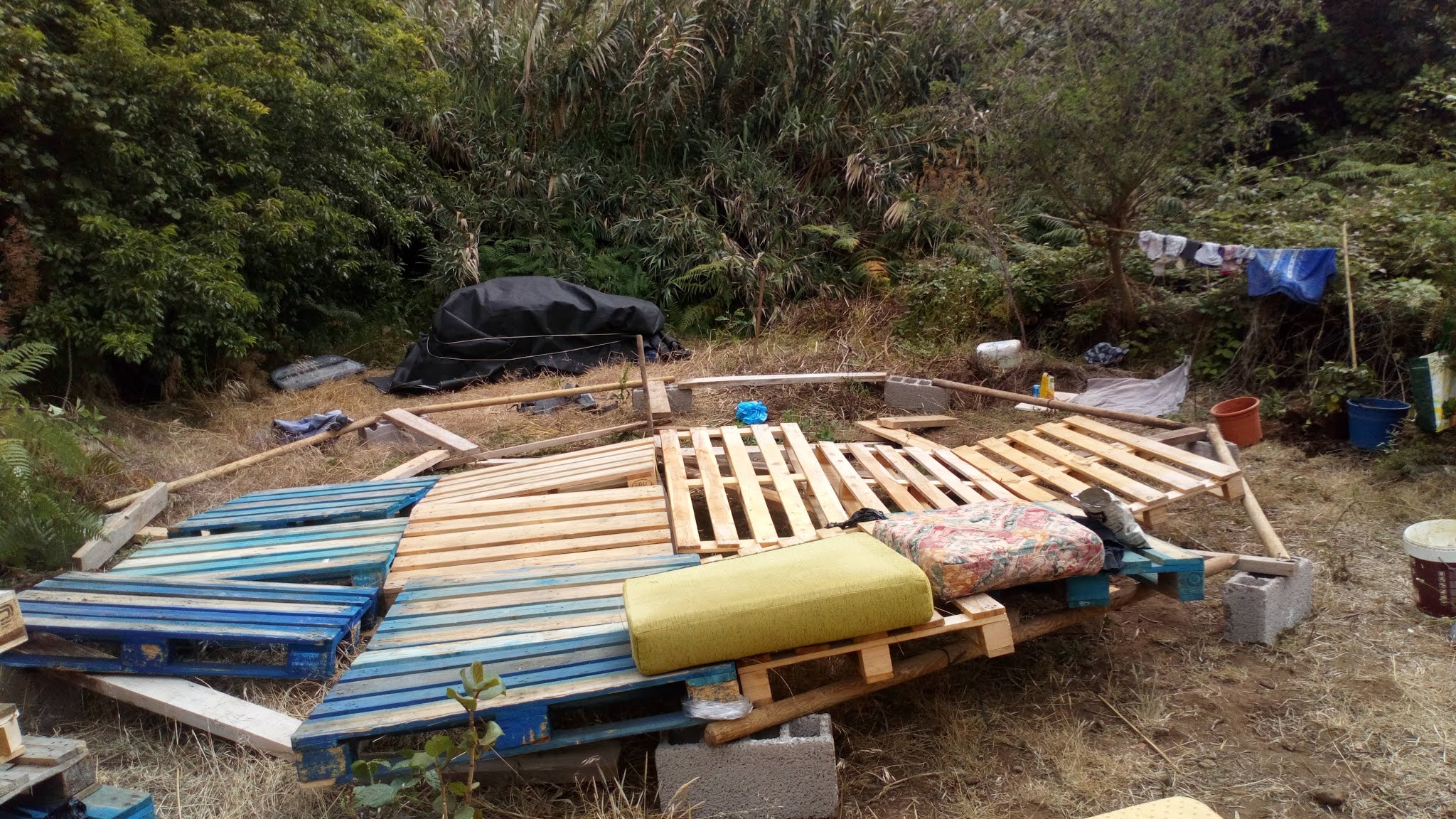
It took quite a bit of time and effort to get the thing up.  Just getting it delivered to the land was the first obstacle.  Jenny ordered a second-hand traditionally crafted Mongolian yurt from the Catalonian company tipiwakan.  On their website they impressed us with their bold claim that they would deliver "a cualquier punto geografico del globo" - to any geographic point of the globe.  In an email I pointed out to them that we wanted it to be delivered to the top of a very steep narrow road with a very tight bend in it.  They can't have paid much attention to this detail because from Santa Cruz they contracted a big lorry who took one look at the tight bend before driving back to Santa Cruz, where the yurt was stored until we hired a van to take it up ourselves.   We had all the component parts of the yurt but first had to build a strong flat floor raised above the ground.  This we achieved with concrete blocks, which supported a frame of wooden planks, which themselves supported a floor of wooden pallets, upon which were fixed chipboard boards.  The chipboards were purchased but the rest was salvaged from refuse skips of building sites, or found lying around.  Getting all this material up there posed a few obstacles.  Jenny bought a second-hand van with plenty storage in the back, but it just wasn't powerful enough to get up that tight steep curve.   Once I got part way up when the wheels began whirring ineffectually on the spot.  I reversed a little bit and tried to give it another go, then reversed again and ended up going forward and back until the van was sitting precisely across the road at the steepest and sharpest part of the curve.  I had already shattered the back window by bumping into a wall and there was no way of going forward at all.  To me the van was well and truly stuck, and I thought that only a helicopter would be able to liberate the vehicle and free up the road.  I walked down to the garage of the village and asked for help.  Bienvenido (whose name, fittingly, means 'welcome' in spanish) had already come to my rescue by pulling the van out of a muddy rut on the land (when I had previously managed to drive up the hill.)  This time I told him that I considered the prospects of extricating the van to be unpromising.  In his graceful rugged masculine way he approached the problem with the coolness of a hemingway hero.  Another villager - the only one with a 4x4 slim enough to fit through the narrow lane which came out above the van - attached a cord to the front of the van and pulled uphill while Bienvenido, with a rope attached to the back of the van, pulled downhill, making the van simply slide across the road and rotate into the right position.  I was greatly impressed by the mechanical savoir-faire of these village gentlemen, and their unfussy willingness to club together to help out a new arrival in need.  A little crowd had gathered to spectate and comment on the happening.  I must have mentioned my gratitude for the men's helpfulness to a woman standing at her doorstep nearby, for I remember her opening words, "we are a small village here in Tierra del Trigo," followed by her simple, smiling, closing remark: "but we have a big heart."  I offered Bienvenido some money for his very welcome assistance, but he brushed my offer easily aside by saying, "let's have a whisky together sometime," and thereby completed for me his credentials for belonging in a hemingway novel.


The yurt herself was surprisingly easy to set up:  first establish position of door, tie together five flexible lattice walls in the desired circumference (these lattices could be set taller whereby the circumference would be smaller, or they could be set shorter in which case the circumference would be larger), set up the central cupola atop two poles (first tied to the door and lattice wall for stability), then as each of the eighty roof poles got slotted into the holes around the cupola and tied to the top of the lattice wall at the other end, the whole structure became very strong and self-supporting.  It could be assembled or dissembled in a matter of hours.  Not one nail or tool of any sort was needed - just pieces of wood tied together.
Then the clothes came last - first an undergarment of white cotton, then strips of thick isolating felt, attached to the walls with cords from the door all the way round to the door again.  and finally a heavy waterproof canvas, with a hole in the middle to allow the sunlight in or the chimney to stick out.  When it rained we took down the chimney and pulled over a square piece of canvas to close the hole.


Making a solid floor off the ground was the part which required most time and effort and planning.  We decided to make a central circular block of stones, which we finished off with cement, and later a mosaic of cracked tiles, on which the stove sat.  The surrounding structure of cement blocks, wooden planks and pallets were all of varying sizes, and this required very precise micro adjusting, digging a hole for a cement block to sit ever so slightly lower here, adding a little more earth to a hole to raise a cement block by a few millimetres over there, the whole time handy with the spirit level to ensure perfect flatness over the 28 square metre surface.  It was autumn when I was working on this, and often rainy.  Many times when the rain came on I would cover all the wood with plastic sheets and had to wait it out - sometimes for days at a stretch - before it was dry enough to work again.  
This waiting while sheltering and sleeping in a tent, waiting and wanting the yurt up, watching the rain and wanting the sun out and having to accept each drop of rain, watching and waiting and wanting: this led to a great feeling of accomplishment when the yurt was finally up.  The fact is that parts of the yurt had been left on the land for months while we were demotivated by our own story and distracted by Gabriela and whatever was going on in the south.  The wooden lattice walls, still wrapped in their plastic packaging, had meanwhile begun to go mouldy and provided a cosy spot for a colony of ants.  If the yurt wasn't put up when it was, if the wooden parts had had to spend the whole winter in the moist air, it seemed that the whole project would have had to have been scrapped.

past conditional

Even with the yurt finally up, it let little stress points seep in between Jenny and I when during heavy rain the water streamed successfully down the outside canvas, collecting on the fringe of the chipboard floor which stuck out all around the yurt, soon forming puddles which encroached into the yurt, pulling us out of sleep in the middle of the night to move mattresses and cushions and soak up the encroaching water with towels and sheets and regularly wring them out out into the rainy night.  I don't know why I made the floor far wider than the yurt.  If I had thought about it long enough it should have struck me as obvious that the water, being shed off the canvas cover, should be able to fall directly and unobstructed into the ground.  In my thoughtlessness I only thought that it would be far better for the floor to be too big than too small, and that it might be quite attractive to have a shelf around the yurt to sit on, or to put plant pots upon.  The final job was therefore to trim the floor so that it stuck out only a few centimetres from the yurt, which involved sawing laboriously through pieces of pallet and reconfiguring points of support.  This has been only partially achieved; one side of the floor now slopes down noticeably where support has not been provided.  Indeed the whole yurt now stands slightly askew; jenny now speaks of waiting till summer and consecutive days of guaranteed sun before taking the yurt down and doing the floor again properly.


The whole project of constructing a living space - a place to live - intertwined with living beings - a panoply of plants - became the most engrossing, endearing, satisfying, all-consuming project to date.  It was an entire life project, marrying artistic eye for detail with real practical needs.  There was always something to be done, a frothing over of thousands of little projects or big projects in our minds.  Often the flow of a day's activities dictated that an activity which in all earnestness I had begun the day intending to attend to got sidelined by brute reality be it rain or the need to reconsider the storage of food after the rats had been busy of a night or the need to dig a big new hole for the compost toilet, which necessitated first clearing away all the brambles and while I was there I might as well saw off those straight strong branches to make a fence at the front while at the same time opening up the view to the sea . . . or maybe there was suddenly the strong desire to restructure the unstable stone steps leading down to the lower terrace, and while I was searching or digging for big buried stones I would come across the most gorgeous moss-covered rock in the middle of the woods and knew it would go perfectly at the side of the rock garden, and that then became the main heaving focus of attention.  I mean a real fizzing over of energy, when there is a slight pang of regret at the end of each day when the tools have to be put away . . . or sometimes not, sometimes still continuing by climbing up the tree by torchlight and working away engrossed for hours with a machete cutting back the rank incredible growth of the brambles which have thick wooden stems of several centimetres and seem about set to take over the world, so intent are they to climb up and smother the tallest of trees and completely cover abandoned terraces.  Vamos, very successful survivors.  Amidst all these jostling desires and needs - to work and improve the land and lick it into beautiful landscape shapes and cultivate vegetables and remove weeds and water all thirsty plants at the end of dry days and gather dry wood from the dead limbs of trees which have taken over the abandoned terraces on the surrounding hillsides and light a fire and get round to making some food and washing Gabriela's dirty diapers and clothes and hang them around the stove to dry before sitting down to enjoy a good plate of food - I say, amidst all this, there is the preponderant need and desire to be with Gaby.  To simply be with her, to lavish her with the attention she craves, to hold her and comfort her and go for a walk with her in the morning to the well to get good drinking water while mama Jenny gets to lie in, or take her out on her wheelbarrow chariot to the local níspero tree and climb up and collect pocketfuls of creamy yellow fruit which Gabriela, satisfyingly, eagerly devours, or to wonder with her under the night sky and hear her little infant voice of wonder at the brightness of the moon, or on a mid-afternoon, to swing her softly to sleep on the hammock while softly singing songs of love to her,
lots of love,

Gabriela,
how come you get to be so amazing?


lunedì 25 gennaio 2021

taubi


The pigeon entered our lives quite matter-of-factly but, all the same, the event was shrouded in an air of strangeness.  Why did he choose precisely Jenny's door, among all the doors he could have chosen on the long corridor on the second story of jenny's block of residential flats?  How did he gain entry to the block of flats anyway, all access doors to the street always being closed?  Could he have hatched in some recess on the cliff behind the block, and might his parents have been chased away or murdered by a cat, and could it be that he had somehow escaped detection by the cat, and had come now to present himself at jenny's door, somehow intuitively seeking her protection? 

We first heard his soft call from inside the flat and did not know whence it came and hence thought nothing of it.  Then about twenty minutes later we heard it again, clear and insistent.  This time Jenny opened the door and he waddled straight into the flat, as if he had been waiting to do just that.  He was very small; it seemed that he couldn't have been more than a few days out of his egg.  He had a strange swollen knobbly beak and a self-assured manner.  I thought that he probably belonged the goose family, and suspected that he was of Asian origin.  Jenny agreed that he looked strange, but had a hunch that he could be a pigeon.  After some searching online, sure enough, she came across a photo of a young pigeon whose appearance corresponded exactly with our little chick's.  We learned that the knobbly beak is only found in the young, and is replaced by a stronger one in adulthood.  We learned that of all birds the pigeon family is the most widespread and numerous, and that strictly speaking there is no agreed upon way to say when a pigeon is not also a dove.  

Jenny's childhood on a finca in rural Paraguay was filled with intimate animal friendships, from a horse and cows to pet parrots and a pet monkey, from a pet rat called fred whom she would smuggle into her school classes in the pocket of her coat, to a hen who would follow her as she walked several kilometres to school and wait for her by the school gate to then walk home with her after classes.  Could little pigeon have somehow sensed Jenny's love for all animals or why else would he have waited and called insistently like that at her door?  

In any event Jenny soon took him under her wing, making him a little nest under a leafy plant pot and feeding him by making a bottle of bird paste, pecked at by him through a hole in a condom stretched over the bottle opening (which, Jenny read, simulates the experience of having to reach into mama's beak.)  It wasn't always easy to ensure that he was eating enough and it required a fair amount of patience and dedication on Jenny's part.  

Jenny's love of animals, or perhaps her maternal instinct, made her instinctively help out pigeon, but it was to become a relationship not without its frustrations.  Although I still catch myself calling him just pigeon, Jenny has come to call him Taubi (Taube being the german for pigeon.) Taubi would shit indiscriminately all over the balcony, which hindered hanging up clothes to dry there.  He was free to fly off and discover the world if he wanted to (which any parent or parental representative would have wished of him) but instead he would perch there for hours cooing and purring and dancing himself into a trance.  He is not exactly a normal pigeon.  He is mostly obsessively attached to Jenny, and will flutter over to wherever she is sitting and, cooing all the time, will perform a purposefully choreographed dance in front of her (which jenny, perhaps correctly, interprets to be a courting dance.)  However, he is a single-minded and short-tempered creature, and it is not beyond him to behave aggressively even towards Jenny.   Over time he has warmed a little towards me and doesn't usually mind me picking him up, although when he is feeling truculent he is wont to deal me deft martial art swats with one wing, which always catch me unawares.  Jenny says he is jealous.  Sometimes he feigns to bite all of my fingers, but I don't think he means any harm because it really doesn't hurt.  It just tickles.  Perhaps it is just his way of showing affection.  

We took him to the cave where other wild pigeons would fly past but he never showed any interest in them.  We thought that all he needed was to meet a young female pigeon and he would be sorted for life - pigeons being monogamous - but no, he haughtily ignored any interest from other pigeons and didn't even seem fond of the rocky coast around the cave.  He might stay for a day or two, but would eventually fly the three kilometres or so back to Jenny's flat and be found invariably back on his balcony, coating everything with his droppings and annoying the neighbours with his mad cooing.  


We thought we had found the solution when we took him to the land Jenny had bought above Tierra del Trigo.  Surrounded by forested hills, he did seem to like the place more than the cave.  He was more contented, less given to his catatonic cooing, and would fly around and accompany Jenny on any outdoor project of hers.  However, we soon realised that he only stayed on the land as long as Jenny was also there.  If I stayed alone on the land with Taubi, he might stay for a few days with me, but at a certain point would take wing, and in a matter of hours Jenny would report that he had arrived back at the balcony in the south - a distance of perhaps twenty kilometres as the pigeon flies (and at least double by the twisty roads).  The homing instinct native to Taubi's breed has in his case been set, seemingly irrevocably, on the balcony of Jenny's flat.  Jenny suggests that we could try taking him across the sea to one of the neighbouring Canary islands and see if that doesn't flummox his homebound bind, or, failing that, try mainland Europe.


lunedì 4 gennaio 2021

unalloyed love


"what two words come to your mind when you think of this cave?" asked mario when he came by to visit a few weeks before they pulled it down.  "pure love" i said without even thinking.   i suppose "love" would have done; "pure" only served as an intensifier due to the two word stipulation. now that they have pulled it down i reflect that it is wonderful to have loved a place to such a degree for so long at all, even if 'our cave' as such is no more.  as to the question of ownership of or entitlement to the cave, Jenny often reminded any disputer that it was Papa Teide who created the cave, and his creation it would for ever remain.  (El Teide is the volcanic vent which flung all of Tenerife above the sea in the first place.)  

how naïve of us to have imagined that our cave would probably be considered exceptional and exempted from the general cleansing.  "of course they want to remove the messy constructions put up all along the coast" we thought, "but anyone can see how much love and care we have put into this place." the particular beauty of this place is undeniable and overwhelming . . . or so we thought.  others concurred, and commented that this concave fold in the rock deserved be conserved - not inhabited by any one person, but kept open, empty and natural - as a place for contemplation.  we had left behind a fetching image of Jesus, pointing at his sacred heart, wearing a calm inscrutable mona lisa gaze, and with long flowing blonde hair, looking just like a mild-mannered jimmy page.  along with a statuette of the madonna with child, we thought that these icons might emanate peace and awaken an attitude of compassion among the catholic police force.  indeed i found that they had been respectfully removed from the cave and reverently placed under a cactus up the hill, whereas the door and window of the cave - which Jenny had once salvaged from a shipwreck - had been ripped out.  The morning they came to knock the walls down I was hiding out in Pepe's old cave by the sea, feeling like a fugitive because of the security men who came down with bright torches the night before.  I had wanted to spend one last night in the cave.  There was still a group of policemen standing by the scattered stones as I appeared the next morning and attempted to casually walk by.  I saw from their tense faces that they were here on a serious mission: to erase all illegal dwellings along the coast, and that they would brook no dissent. This time they had been much more professional and efficient. Nothing had been burned like in the last wave of evictions but long lines of workers had worked hard to carry everything out.  They barked at me to put a mask on, and to show them my documents, and said that no-one was allowed here while they were clearing up, so I'd better clear off.  I told them untruthfully that I had not lived here; had only spent time here occasionally.  Something in the way I eyed the cave painting - exposed to full daylight for the first time - made them ask me if I had painted this.  I assented and they asked aggressively, "what if we were to come to your country and paint the rocks there?"  I imagined for a moment the Salisbury Crags covered with colours and thought that it might not be that bad, but yes, objections could be raised, and hmmm, yes, in retrospect it would have been better to have left the rocks unpainted.  The irony is that the greatest part of the south coast of Tenerife has been disfigured by indiscriminate hotel building, holiday apartments, golf courses, commercial centres, etc, and elsewhere covered by blanket banana plantations, leaving very little room for any natural environment, compounded by the discarded detritus from construction projects lying all around, and other accumulations of all types of rubbish from careless, throw-away society.  I can appreciate the official stance that, amid such run-away construction, it is worth putting aside one area to be preserved as unbuiltupon land, but why not treat all land as having its own intrinsic worth, to care where possible for its elements of natural beauty, instead of saying:  here we can defile.  here and here and here is all okay to defile, but not over there.   Later I found the window and the door, still intact, on a skip at the top of the hill, and came back to salvage them.  I took them to a strip of land which Jenny had bought above a little village called Tierra del Trigo in the north of the island.  A lot of the plants which I had tended over the years had been squashed by the rubble; I dug them up and took them to the land too.  Mostly the agaves, which can endure much hardship, and a few choice cacti.  I had found one broken off cactus limb lying by a layby, who suddenly blossomed not long ago after I planted him outside the cave, encouraging him with sparing little drinks of water.  I think he was a queen of the night, because of the brevity of his bloom.  I came down to the cave one night and was gradually overcome by the most enchanting perfume filling the air.  It took me a while to realise where it was coming from; in no time this once discarded limb had rooted and drank and had now pushed out the most beautiful scented single white flower, making me feel touched and thanked. At first light next day I took some photos, and the next day the flower had already begun withering.  I found him buried and bruised under the rubble, and have carried him now to the land, where I am sure he will get on fine.  All the aloes I left at the cave; they didn't seem to need much water to grow healthy and strong.


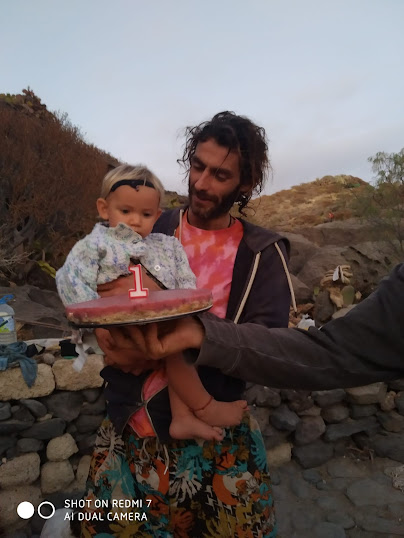


Back in March - just before lockdown - we were delighted to be able to celebrate Gabriela's first birthday at the cave.  Gabriela was radiant and relaxed.  We had invited a discreet group of friends, and had a barbeque and some beers.  

Everyone in la Caleta said that it was the best lockdown they had ever had, which I found a funny thing to say, given that there hadn't been any precedents.  It is true that the caleteros lived it up largely, with no tourists or excursionists to intrude on their idyllic stretch of sun-drenched coast, gathering and playing music on the beach at night, with very little regard for maintaining social distancing, I imagine.  One young German went out fishing with his mate on a canoe and proudly posted a video of it online.  This could have contributed to the triggering of the ruthlessly efficient clearing out that summer, when lockdown had loosened.  Apart from the question of keeping the natural environment untouched, there was a social aspect to it, where local residents resented that their coastline had been usurped by largely socially misfitted foreigners.  Already viewed with suspicion due to their unconventional ways, publicly flaunting lockdown restrictions when all other citizens were kept imprisoned in their homes was taking just too many liberties.  After the evictions the beach in the summer swarmed with canarian families, visibly very happy to have their beach back.  Looking back now, what is surprising is not that they eventually kicked us thoroughly out, but that such free living was tolerated there at all and for so long.  "one of the truest anarchist communities I have came across," Dante said to me recently.  this had its undoubted perks, but its drawbacks too.  Dante wanted to be able to play guitar and sing from full lungs at 4 in the morning, so having no rules was just right for him.  Once Jenny and Gaby were trying to sleep while they were blasting out music from huge loudspeakers powered by a generator above the beach - about half a mile away, but big bass booming right into the cave.  2 or 3 in the morning. I ran round and said to a few people: hey, the baby is trying to sleep, do you mind turning the volume down a bit?  all they did was grin with their party grins and say: "tell them to come and dance with us"  to be fair a fairly well functioning communal space was created above the beach: seating area, shade from sun, fire pit, clay oven, pizza nights, meals made, wood collected, water collected, refuse disposed of.  there were always those who wanted a little more organisation, more participation, not always the same people doing the same tasks.  there was a great range of experiences and stories and motives behind the people who spent time in la caleta.  it can't be denied that the place exerted a powerful influence on certain people; it was a deeply appealing place to be.  many people would initially be passing through, and would end up lingering until in the end they somehow could not leave.  quite a few people went crazy.  jenny used to talk about decorating little bottles and labelling them as the lost souls of hippies, and selling them to the tourists.  it is possible to smirk at jenny's macabre sense of humour here, but thinking about it now, i feel aghast at the mere phenomenon of a lost soul.


sabato 14 novembre 2020

my cherry picked Colin Wilson

Browsing around Glasgow's Mitchell library the other day, my eye was caught by a thick book entitled 'The Ultimate Colin Wilson.  Writings on Mysticism, Consciousness and Existentialism'

Flicking through the pages, it didn't take me long to take the book out on loan and become thoroughly engrossed in its reading.  I sort of literally could not put it down.  I closed its pages only shortly before closing my eyes at night, and opened them again shortly after I had opened them again in the morning.  The bullet points below are citations or phrases or fragments of ideas that struck me.  I paraphrased some of them to suit my understanding and so I can't say that these selected snippets are fully faithful transcriptions of Wilson's words, but most of them are more or less so, to my understanding.  Wilson himself is fond of rephrasing.  Of the hundreds of books which I have subsequently learned that he has written, he admits to having centred on essentially the same main ideas, which he approaches from different angles or decorates with diverse references to philosophy, literature and tales from everyday experience. 

One recurring theme running throughout Wilson's writing is the 'peak experience' - when one is overcome by a feeling of immense well-being: joy, ecstasy, elation, wonder and awe, as if one had received (in the words of G.K. Chesterton) "absurd good news."  Maslow first coined the phrase 'peak experience' in describing religious/spiritual experiences where ego consciousness disappears and is replaced by a blissful awareness of the underlying oneness of All.  Discussing this later with Wilson, Maslow reported that, although such experiences could occur among all types of people, certain very healthy individuals were most prone to them and that, in the process of describing and dwelling upon their experiences, they were found to recur with an ever greater frequency. 


  • 'We started on one of those clear dawns that wake up the senses with the sun, while the intellect, tired of the thinking of the night, was yet abed.  For an hour or two, on such a morning, the sounds, scents and colours of the world struck man individually and directly, not filtered through or made typical by thought; they seemed to exist sufficiently by themselves, and the lack of design, or carefreeness in creation no longer irritated.'        T.E. Lawrence in Seven Pillars of Wisdom
  • 'Why did I suddenly feel so happy, hanging there like a fly, looking down at the lights thousands of feet below in the valley?  So many are lying there comfortably in their beds, not particularly happy because they take their beds for granted.  All suffering from what you could call false fatigue - a mistaken feeling that life is not really worth living.  Suddenly the absurdity struck me: we have climbed this mountain to remind ourselves of something we ought to know anyway - that life is only worth living when the will is concentrated.
  • What we call waking consciousness is not usually much better than sleep.  We are still wrapped in a passive, sluggish day-dream.  This is not due to some natural limit to consciousness, but only because we remain unaware that it can be stretched.  We are like dogs who think they are on a chain, when in fact they are free.
  • 'peak experiences' remind us that everyday consciousness is a kind of tunnel and that we only have to remove the telescope fixed on the one cloud on the horizon to realise how unlimited the big blue sky is.
  • the 'ordinary consciousness', which we have taken for granted as the only kind of consciousness, is a poor substitute for the real thing.  Mystics have always experienced this insight, and found it hard to put into words simply because all our language is based upon the premise that ordinary consciousness is the real thing.
  • The Outsider is the heroic figure of our time.  He feels alone in the crowd of the second rate.  He could be a saint or visionary, caring for nothing but one moment where he understands the world or sees into the heart of nature and God.  He is a symptom of our time, a rebel against the lack of spiritual tension in a materially prosperous age.
  • 'If I had to stand on a narrow ledge for ever and ever, in eternal darkness and tempest, I'd still rather do that than die at once'    Rashkolnikov, in Crime and Punishment
  • 'Art, that makes life seem like a game, and withdraws us from the common fate'  Wagner
  • 'Vanity of vanities, all is vanity.'     Ecclesiastes
  • 'There is nothing new under the sun.'   this gloomy feeling haunts so many outsiders - those looking for those magical wow moments.
  • 'The Ecclesiastes Effect' is expressed with gloomy power in the philosophy of Schopenhauer.
  • Dostoevsky, Nietzsche and Van Gogh were perceivers of other realities which brought about a dissatisfaction with ordinary consciousness and its emphasis on the immediate and trivial.
  • Mental illness is basically caused by the collapse of the will.  When you make an effort, your will recharges your vital powers as a car recharges a battery when you drive it.  If you cease to will, the battery goes flat, and life appears to be futile and absurd.  To emerge from this state, all that is necessary is to maintain any kind of purposeful activity - even without much conviction - and the batteries will slowly become recharged.
  • 'I felt the need to test the power that had entered me, and I began to dig in the fierce afternoon heat for more than an hour at a rate that I ordinarily could not sustain for two minutes.  I felt no fatigue, and no sense of effort.  Moreover, I felt a clarity of thought that I had only known involuntarily and at rare moments, but which was now at my command.  The phrase 'in my mind's eye' took on new meaning as I 'saw' the eternal pattern of each thing I looked at: the trees, the plants, the water flowing in the canal.  I remember saying aloud: 'now I see why God hid himself from us' but even now I cannot recall the intuition behind this exclamation.'    [here Wilson is quoting an author whose name I did not note]
  • If some benevolent deity gave every person the equivalent of a million pounds, not much more happiness would be produced; most people would soon find reasons to feel dissatisfied.
  • This is the paradox of human existence: man knows what he doesn't want far more clearly than he knows what he does want.
  • As Fichte says: to be free is nothing; to become free is heaven.
  • 'Dante's inferno is a picture of human society in a state of sin and corruption, like our own, racked by futility, lack of living faith, drift into loose morality, greedy consumption, financial irresponsibility, self-opinionated and obstinate individualism, violence.'     Schumacher
  • Authenticity is driven by a deep sense of purpose.  Such a sense of purpose cannot exist unless we first assume that our sense of contingency is a liar, and that there is a standard of value external to everyday human consciousness  [mystical consciousness.]
  • The metaphysics of religion [and not its dogmas] affirm the existence of an external value system [which Wilson would like to call 'new' existentialism]
  • [which Wilson contrasts to the 'old' existentialism, which espouses materialism, where there is a 'total contingency' (non-necessity of being so)]
  • Man's evolution depends on a renewal of his sense of overall purpose.  For biological reasons we are blinkered, like horses in the traffic.  We are capable of altering our immediate responses and values in favour of a more embracing value system.  Every moment of our conscious lives depends on the value systems we adopt.
  • The narrator in Powys' novels wants to see events from some universal point of view in which the algae in a stagnant pond and the grubs in a rotten tree are as important as the human characters.
  • Powys: 'I became aware, more vividly aware than I had ever been, that the secret of life consists in sharing the madness of God; the power of rousing a peculiar exultation in yourself as you confront the inanimate, an exultation which is really a cosmic eroticism.
  • Healthy optimistic minds repel ordinary misfortune, whereas accident-proneness and general bad luck are the result of a psyche made vulnerable by defeat or stagnation.
  • We say something and mean it only when Faculty X [Wilson's term for a higher state of awareness] is awake.
  • Faculty X is the key to all mystic and poetic experience; it is the sheer affirmation experienced by Wordsworth and Shelly and Blake.
  • When Faculty X is awoken life suddenly takes on a new, poignant quality.
  • Faust is about to commit suicide when the Easter bell rings, bringing him back to childhood; suddenly faculty X is awake and he knows suicide to be the ultimate laughable absurdity.
  • In Proust's novel, the narrator dips a madeleine into his tea and is suddenly thrust back to childhood: 'an exquisite pleasure had invaded my senses.  At once the vicissitudes of life had become indifferent to me, its disasters innocuous, its brevity illusory - I had now ceased to feel mediocre, accidental, mortal.'
  • Faculty X is a sense of reality, the reality of other places and other times, above and beyond my ordinary senses that tell me that here and now is all that is real.
  • What is consciousness for? When you are deeply asleep, you have no consciousness.  When you are very tired, consciousness is like a dim light that hardly illuminates anything.  When you are wide awake and excited, consciousness seems to increase in sheer candle power.  Its purpose is to illuminate reality, to reach out into its recesses and thus to enable us to act upon it and transform it.  When it is low, reality becomes 'unreal'; as it becomes stronger, reality becomes 'realer': faculty X.
  • The birds are creatures of the air, fish are creatures of the water; man is a creature of the mind.     H.G. Wells
  • An animal cannot disobey its instincts; humans disobey theirs a hundred times a day.
  • 'Our inner robot' is the unconscious servant who performs all automatic tasks of everyday life.  When I am energetic and cheerful, the robot stays in the background and I walk around with my senses wide awake.  As I get tired, the robot takes over more and more of my functions and the reality around me becomes less and less real.
  • With the senses closed, one suffers from 'meaning starvation.'  Human beings accept the lack of meaning with stolid fatalism, as an animal accepts illness and pain.
  • If I want more meaning, then I must force my senses wide-open by an increased effort of will. Meaning is proportional to the intensity of will.
  • Gurdjieff's tremendous vitality impressed everyone who met him.  His method depends on forcing people to make unusual efforts to release their vital reserve.
  • concentration - intensity - intention -  volition - purpose - appetite for life
  • To put it crudely, you could say it is as if you had Bertrand Russell in one side of your head and D.H. Lawrence (or Walt Whitman) in the other; the result is non-stop hostility.
  • The left-brain hemisphere adopts a worm's eye view of reality and is concerned with analytically apprehending surface facts; the right-brain hemisphere adopts a bird's eye view of reality, seeing the 'big picture', perceiving deeper meanings and underlying connections.
  • Under hypnosis one is able perform extraordinary feats - when the conscious left-brain is shut down and replaced by the authoritative voice of the hypnotist.  One cannot perform such feats in a conscious state, when the left-brain is in control, simply because one does not believe that one can.
  • D.H. Lawrence and Henry Miller tell us that 'head consciousness' is dangerous and stupid and that we ought to trust the 'solar plexus' [instincts.]  However, the main problem is not that 'head consciousness' is overconfident and conceited, but that it is far too weak and diffident.
  • The left-brain/right-brain view of the human entity gives altogether firmer grounds for optimism about man's future.  Our real trouble is not that we are at the mercy of sinister dark forces, but that we are enfeebled by an unjustified lack of self-confidence.  My problem lies in my attitude to myself, my tendency to premature defeat, my failure to grasp that I am, in fact, in control. 
  • I could be compared to an excellent army with incompetent and inexperienced officers.  This is a far better situation than an army with good officers and hopeless soldiers.  The thought of inexperienced officers [the left-brain function] makes us aware that human beings are young and inexperienced in an evolutionary sense and therefore these problems are little more than teething pains.
  • A deliberate and conscious effort of control, based upon a change of attitude, ought to bring about an immediate change in the quality of one's consciousness.
  • Jung's method of active imagination through letting go - lying totally relaxed, but in a state of wide-awake vigilance - could be regarded as the simplest, and most effective, of mental therapies.
  • Once the real existence of our 'other self' [our 'hidden ally'] has been recognised, the next question is to tease it into expressing itself.  Many people experience it in the form of auditory and visual hallucinations - Jung's projections.
  • Jungian Barbara Hannah postulates that ancient man's encounters with God are instances of active imagination.
  • Ancient man was perhaps unicameral [one-brained]; in a relaxed, instinctive state of oneness with nature, like a cow.  Being in Tao and in himself.
  • Jung's individuation: being dominated by the left-brain which, unaware of the 'hidden ally', is inclined to over-react to problems.
  • Active imagination is not Rimbaud's 'reasoned derangement of the senses', directed by the ego.  It is an inner harmony based on the recognition of the hidden ally, leading to a process of cooperation between the two selves.
  • The right and left brains can eventually achieve the same relationship as a great conductor with his orchestra, which has come to respond to his most delicate gesture.  Such a state of harmony depends on the initial recognition that I am the conductor.
  • 'Consciousness is the supreme arbiter.'    Jung
  • Once man has made the discovery - that when a wild horse ceases to be wild it becomes an invaluable servant - he looks around for new fields to conquer.  All games are designed to create stress and then give us the pleasure of controlling it.  Hence: the battle of Waterloo was won on the playing fields of Eton.
  • Kant's attitude to knowledge was passive, whereas to really grasp reality it should be active.
  • 'I seem to be a verb'      Buckminster
  • Fichte's insight: a part of our minds creates the world 'behind our backs.'
  • To know something with the mind is hardly to know it at all.  Our whole being is involved in true knowing.
  • Husserl: perception is intentional.  When we see something, we fire our attention on it like an arrow.  But if there is an intentional arrow, there must also be an archer to shoot it.  It is active, not passive ... like a hand reaching out and grabbing things, not just a searchlight.
  • Bertrand Russell is a sad example of staying in the 'Cartesian' mode for too long; always (passively) asking 'what can I know for certain?', without ever finding an answer.
  • Paul Ricoeur: the very seeing itself is a doing, a producing, a creating.  
  • Husserl's intentionality culminates in seeing recognised to be a creative vision.
  • Sartre recognised that we are free, but because he failed to see the creative role that we play in constructing our reality, he ultimately saw no way out of the morass of being in a meaningless world.
  • It is as impossible to exercise freedom in a meaningless world as it is to jump while you are falling.
  • There are only two pockets in the billiard table of philosophy: materialism and idealism; no matter how 'original' a philosopher, he is bound to end up in one or the other.
  • Wittgenstein's demonstrably inadequate philosophy sets out to impose limits on the world and its meaning.  It reduces meaning to the narrow and commonplace, saying 'if we want more than that then we are suffering from delusions.'  He is trapped in Heidegger's 'triviality of everydayness.'
  • For Derrida words have no innate meanings; words vary freely in different contexts.  For Derrida philosophy is a kind of spume on the surface of the sea of language.
  • We tend to climb towards higher states of self-awareness by means of a series of self-images; we create a certain image of the sort of person we would like to be, then try to live up to the image.
  • 'The great man is the play-actor of his ideals'    Nietzsche
  • 'Even war cannot frighten us enough'     Auden
  • In a Universe infinite yet bounded within its framework of endless repetition, anything can be done.
  • In Zarathustra, the Eternal Recurrence is recognised as the foundation of an essentially optimistic philosophy.
  • Left to ourselves, the prospects for humanity seem dark.  I do not believe we are left entirely to ourselves, but neither can we forget the problem and leave it to some anthropic principle to steer us through to a solution.  God helps those who help themselves.

martedì 20 agosto 2019

crab for breakfast this morning?

I awoke this morning thinking that it was my 35th birthday. I reflected that I was now half way to being 70, and who would dispute that 70 years is a decent timespan for a life to live out its lot? I had reached a middle age - no longer a young adult and not yet an old one. I considered whether there might be a crisis looming. Am I happy living my life the way I am living it? Am I really on the right path? What's it all about? Whereto and wherefore? Then I became informed that in fact only 34 full years had passed since I was born, and was overcome by the strange delicious feeling that I had gained a year. By dint of having thought that I would turn 34, I thought that I was in fact already 34, ready to turn 35.

The first thing I saw was a crowd of crabs on the rock in the early morning sun. The bold rescue crab was clamboring up, trying to drag with him a spool of tangled fishing wire - a task which he abandoned as I approached.  I, still rather bleary-eyed from the early morning, joined the rescue operation.  After some careful tugging at the line, which - my care notwithstanding - made the crab with his legs caught pull and dance and finally hang listlessly, I realised that, rather than rescue that crab, I wanted to eat him.


I felt later in a way bad. I felt that the crabs would probably think that it was me who intentionally devised and set the trap, whereby I know that it was (unintentionally) Andrea - I saw him yesterday on the rocks with the reel, swigging at his beer. I had been cultivating a friendliness towards those crabs because at night they scuttle around the tideline when I am barefooted. Lately I have found some of them sitting at the bottom of the rock pool during the day when I have come to bathe the baby, have greeted them and left them alone. Initially I thought I would gain kudos from the crab community for rescuing one of their members, then I saw that it would be more difficult for me to help disentangle the crab than it would be to lower him into a pot of boiling seawater and eat him.

The water wasn't boiling when I lowered him. It was cold. I thought that he might not notice the gradual increase in temperature, but as the water got hotter his scuttling became more and more frantic until he scuttled no more.  Now I wonder if it would have been more humane to have plunged him directly into boiling water, rather than teasing him slowly into his boiling suffering.  I have never personally killed a pig or a cow, and it is sobering to consider that I would not want to either, despite the fact that I am generally happy to eat their flesh once slaughtered by someone else.

The crab I killed was old and venerable, evinced by a film of green algae on his incandescent orange shell. His tasty flesh would have filled a decent sized tin plucked from a supermarket shelf. The crabs are there on the rocks for the taking, but the one who buys the tin is paying not to consume their time in hunting, cooking and removing the shell. Also removed is the question of moral compunction when considering the alert eyes when they are still alive.

Later I spotted another venerable old crab squatting atop the rescue rock, surveying the scene. I wonder if these crabs consider me now to be their enemy. What do their beady eyes see, and is friendliness between species for them at all an option? What is friendliness, is it a survival technique, or does it pertain only to the domain of morality (in itself perhaps a mere means of survival)? Maybe crabs will fight like crabs for their survival, and only at the moment of surrender do they lay down their arms and say (in the manner of a chivalrous cowboy who, clutching his breast, rasps) "you got me partner", before plunging back into the soup of unformed souls. This living game is deadly serious until the moment comes to remove one's mask.